the journey of finding my ancestors... all the people who came before me to make me who I am
14 July 2016
The Beringer mill
24 December 2014
A painting of Jean Gaspard Weiss
Living here in Germany, we are about an hour's drive from Mulhouse in France. The other day I took the opportunity to visit Mulhouse, and start ticking things off my family history bucket list!
First thing on the list was to visit the Musée Historique to see the painting of Jean Gaspard Weiss, my 4x great grandfather. The museum staff showed me where the painting was, as I asked about it, and then I told them that he was my great great great great grandfather, which was met with an exclamation of great surprise! They told me all about him, all stuff which I already knew of course! But it was amazing to see the painting in real life. Today when I Skyped my family back in Australia, I compared the faces of his descendants with my photo of the painting. Yes, there are similarities, even taking into account that it's not the best painting I've seen of him.
I also walked across the square to the Temple St Etienne, where Gaspard Weiss' father was a church musician. It was amazing to think of him in there, playing, over 200 years ago.
So there's plenty more for me to see and do in Mulhouse, but I'm saving those for another time. There will be plenty of opportunities.
22 October 2014
The portrait of Gaspard Weiss and family
The Musée Historique in Mulhouse has a portrait of Gaspard Weiss, his wife Marie, and their eldest child, Charlotte. It is a pastel, and the family has always believed it to be by Sir Joshua Reynolds, the celebrated English portrait painter. I've never been sure of this - the portrait is unsigned, and it is done in pastels, which Reynolds did not usually use.
I decided to do a bit of research to see if I could come up with an informed opinion on the likelihood of it being by Sir Joshua Reynolds, though I'm by no means an art historian!
The portrait is below. I have no access to the full artwork in colour, so I'm showing the available partial colour one (from the CD of Weiss's music), plus a black and white image of the full portrait.

According to information on the back of the frame the portrait is thought to have been painted in England in about 1777. Charlotte, the daughter in the photo, was born in June 1776 - the child in the artwork would definitely be around 1 or 2 years old (though how they managed to get her to sit still for a portrait is beyond me!) which fits well with that date.
Would Gaspard Weiss have moved in circles which might have allowed him to sit for a portrait with such a well known artist? In a word, yes. Weiss had patrons, students and acquaintances who would have had contact with Reynolds. Through Lord Abingdon, who was one of his students, he became acquainted with Lord Cholmondeley (who also became a student) and Lord Wentworth. Weiss dedicated flute compositions to all three of these men. Reynolds had painted Lord Cholmondeley as well as portraits of members of both Lord Cholmondeley's and Lord Wenthworth's families. Additionally, Angelika Kauffmann, who had bewitched Weiss in his younger years, became very good friends with Sir Joshua Reynolds upon her arrival in London. It is possible that any of these people could have made an introduction for Weiss with Sir Joshua Reynolds.
Did Reynolds actually use pastels? Jeffares in his Dictionary of Pastellists before 1800 (Online edition) observes that Reynolds did not seem to like using pastels, but then goes on to give details of his pastel works, though many of them appear to have been studies for oil artworks. The only image of a Reynolds pastel that I can find online is Head and Bust of a Woman (see below), held by the National Gallery of Art, Washington D.C., which in comparison is a very simple work, though it happens to be done in similar colours to the portrait of the Weiss family. Comparing the two, it certainly isn't inconceivable that the same artist might have done both - there is something about the way the eyes are worked that is quite similar.
To compare other artworks of Sir Joshua Reynolds completed around the same time, there are a lot more options to consider.
Reynolds' portrait of Charlotte Grenville, wife of Sir Watkins Williams Wynn and her children (above), held by the National Museum Cardiff, is an oil, completed around 1778. It shows Lady Charlotte reclining with a book, while three of her children play at her feet. Lady Charlotte and Marie Weiss share a similar bored, unseeing gaze (to my mind anyway), and even their profiles appear similar. There is drapery hanging from the lefthand side in both paintings also. The above portrait The Strawberry Girl, from The Wallace Collection, is an oil completed around 1772-3. While the overall tone of the painting is a lot darker than the Weiss family portrait, the lighting on the actual subject is similar - how the shadows fall etc. Diana Sackville is an oil, completed in 1777, held by the Henry E Huntington Art Gallery. Despite the completely different background for the two paintings, the colour palettes are similar, as is the lighting.So I've picked out some of Reynolds' paintings which definitely show some similarities, but it wouldn't be a proper assessment if I didn't compare the Weiss family portrait with the work of some of Reynold's contemporaries. I chosen the major portraitists of the day, including Thomas Gainsborough, Sir Thomas Lawrence and George Romney. George Romney wasn't working in pastels during the period the Weiss family portrait was painted, so we can count him out straight away. Thomas Gainsborough did use pastels, but most of his pastel works have not survived as he apparently didn't fix them.
Gainsborough's pastel portrait of Caroline, 4th Duchess of Marlborough, completed in the 1780s, while beautiful, is of a completely different style to Reynolds' Weiss family portrait. It is done much more in the style of a sketch drawing rather than a painting, with quite a bit of hatching. The colour palette is also very different, with the duchess being rendered in a very white/grey palette, giving her an almost ghostlike appearance. Sir Thomas Lawrence's pastel portrait of Dr Banks Esq, completed in 1784 is also a very different style to that of Reynolds', and to be honest, is much more amateurish - Lawrence was quite young still in 1784.So, although it is not an entirely comprehensive study of English portrait painters in the 1800s, I am quite content to consider that the pastel portrait of Gaspard Weiss, his wife Marie, and their infant daughter Charlotte was actually done by Sir Joshua Reynolds. If you are more of an expert on these things than me I'd love to hear your opinion!
29 June 2014
A trip to Mt Kosciuszko
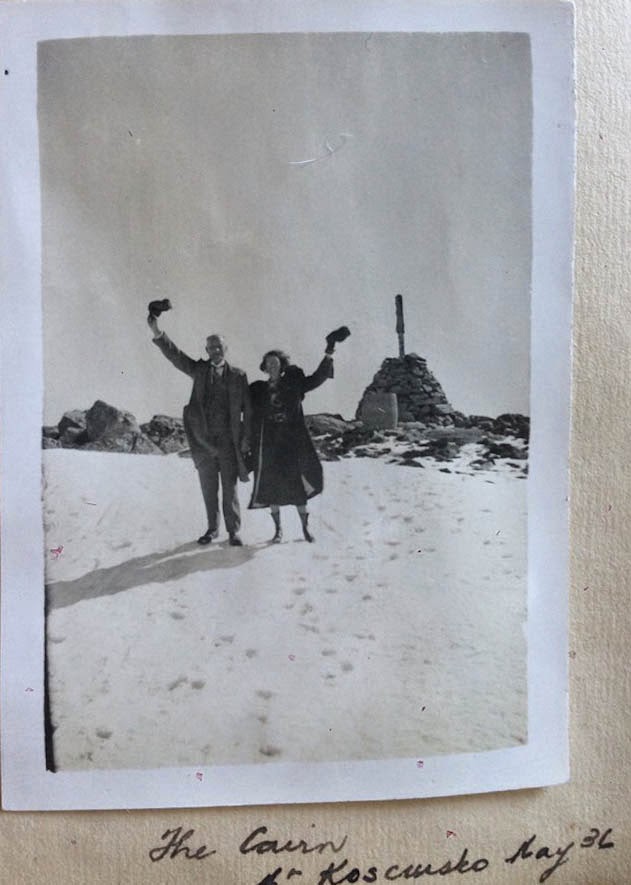
Way back in 1936, when Mt Kosciuszko - Australia's tallest mountain, at 2228m/7310ft - was still spelt Kosciusko (it was changed by the Geographical Names Board of NSW in 1997 to reflect the correct Polish spelling, named after General Tadeusz Kosciuszko), Uncle Les and Auntie Gen took a trip there with Auntie Gen's uncle and aunt, Norman and Mary Macindoe.
They travelled in a 1920s soft top Austin tourer (I think) and they must have been freezing!

They stayed at Hotel Kosciusko. Below is a photo of Uncle Norman and Aunt Mary in front of the hotel (though I actually think this may be the back of the hotel).

They spent a day walking to the summit of the mountain, and although Auntie Gen looks well rugged up, I love that her Uncle Norman is in a three piece suit and tie! The one shown in the photo below is the original cairn, which has since been rebuilt.

Despite the fact that they have rebuilt the cairn at the summit of Kosciuszko, the Seaman's Hut is still standing (here's a link to a recent photo), and looks like it hasn't aged since the following photo was taken. I still can't work out what a seaman would be doing up there on the mountain though!

28 June 2014
Uncle Les and the YMCA
I've written a little about my great uncle Les Davis before, here and here.

Leslie Alfred Davis (1903-1977) was married to my grandfather's sister Gen, both pictured in the photo above. Family legend has it that he entertained the troops during World War II. I had assumed that this meant he was enlisted in the Imperial Forces (which he didn't), and research shows that he never travelled overseas with the armed forces. However he did spend time at Evans Head, NSW, during the war. Careful examination of photos of Uncle Les in uniform at the time show it was a YMCA uniform.
Searching the internet for information on the YMCA in Evans Head during World War II has been rather fruitless, and contacting the YMCA brought no help at all - perhaps they don't actually have an archivist? Going through Uncle Les' photo album this morning, it suddenly occurred to me to look up Trove - I'm not sure why I didn't think of this before! I found a number of useful articles:
![]() |
![]() |
GUESTS AT the Civic Hotel in- clude Mr. and Mrs. Les Davis, of Sydney, who are spending holidays here. Mr. Davis was formerly at- tached to Evans Head R.A.A.F. Station as Y.M.C.A. Welfare Officer, and will be remembered here as a compere of concerts. |
| Northern Star, 17 Feb 1945 | Northern Star, 26 Apr 1945 | Northern Star, 29 Jan 1947 |
So this shows what Uncle Les was doing in Evans Head during World War II - he was the YMCA Welfare Officer attached to the RAAF base there. From what I can tell, as a YMCA Welfare Officer he supported service personnel stationed in Evans Head, presumably through the provision of recreational facilities and other services to assist in maintaining morale. The photos below show Uncle Les in his office, and also in the YMCA Recreation Room at Evans Head, with some RAAF airmen.


25 April 2014
ANZAC Day 2014
Today is ANZAC Day, a day observed in Australia and New Zealand to commemorate all those who served (or are still serving) and died in wars, conflicts and peacekeeping operations. ANZAC is an acronym that stands for Australian and New Zealand Army Corps. Naturally, on a day like today my thoughts turn to my great great uncle Allan Wickham, who was killed in action at the second battle of Bullecourt, France on 3 May 1917. Although I don't like war, I am proud to honour him and all those like him who made the ultimate sacrifice in war, by fighting and dying for their country.
The photo above is of my son, a member of the Australian Air League, laying a wreath at the local ANZAC Day Parade two weekends ago. I was proud that he marched in honour of those who fought and lost their lives for their country, and doubly proud that he was chosen to lay a wreath.
16 July 2013
Tom Wickham, retired policeman
Recently a reader (Graham Sciberras - thank you so much Graham!) sent me a link to a 1962 ABC Four Corners report on the gentrification of Paddington, an inner-city suburb of Sydney. The report is interesting to watch because of the hilarious English accent that so many of the reporters of the day affected, but also, and most importantly, because my great great uncle, Tom Wickham is featured in it. I've seen a few photos of him before, but never seen film of him, so this was brilliant to see!
Mum was visiting my grandfather recently, who is Tom's nephew, and though he is quite unwell, when Mum asked him, my grandfather did remember his Uncle Tom. So today Mum and I visited my grandfather again and showed him a still photo of Tom from the Four Corners report, and also some of the footage from the story. Sadly, the other day my grandfather must have been more lucid because today he just kept looking at the photo and shaking his head. Because of his illness I don't think he could get his head around the fact that this was someone he once knew.
However, should you be interested in what Tom Wickham, retired policeman, looked like in 1962, pop over here and take a look - he's about 2 minutes in. There is a big resemblance to my grandfather. And then compare him to how they imagined him in Underbelly: Razor - slightly different!
![]() |
| Tom Wickham, interviewed for ABC Four Corners, 1962 |
![]() |
| Steve Le Marquand, as Tom Wickham for Underbelly: Razor |
15 June 2012
An engraving of Charles Nicholas Weiss
I borrowed something precious from my great aunt on the weekend. She has in her possession an engraving of Charles Nicholas Weiss. I scanned it, and present it below.
The caption is "Charles N. Weiss. Engraved by F. McCabe from a Drawing by Charles Hayter. London"
Charles Hayter (1761-2 December 1835) was an English artist who specialised in portrait miniatures. He was appointed as a Professor of Perspective and Drawing to Princess Charlotte, daughter of King George IV.
There is very little information available on the engraver McCabe, however I believe he was also known as E.F. McCabe and worked in the 1820s. Two of his engravings are held by the British Museum.
If this engraving was done in the 1820s Weiss would have been about 30-something. The most obvious feature on his face is the hooked nose. Interestingly, my late great aunt, Weiss' great granddaughter, had the same shaped nose.
Edited on 16 June 2012 to add:
It suddenly occurred to me to ask my great aunt what she had known about the subject of the engraving. I rang her this morning and asked her. Her father had believed it was of his grandfather (correct). Family legend said that Charles Nicholas Weiss had gone through three fortunes in his lifetime (possibly correct - who knows?!), and her father was of the understanding that he was "pretty musical" (correct). So despite the family not really having any idea of the fame that Charles Nicholas Weiss had in his day for his flute playing, clearly a little information filtered through, down the generations. My great aunt said that they used to have it framed and hanging on the wall, and then it was put into an album. I'm glad she realised it was important enough to keep!
20 December 2011
Who was the Rev James Dunlop married to?
I have been going through an old photo album of my great aunt's, scanning the photos, as well as trying to work out who they all are. Apart from having many many photos of my ancestors in the Paterson and Macindoe families, it has produced some puzzles for me to solve as well.

The latest puzzle I've been working on is "Rev Dunlop" and his wife "Mrs Dunlop". According to the photos, the Rev Dunlop was married to one of my great great grandfather Thomas Macindoe's sisters. As far as I know Thomas had four sisters: Mary McIndoe (it seems that Thomas used the "Macindoe" spelling of his surname, but the rest of his family generally used "McIndoe"), born 7 April 1826, Margaret McIndoe, born about 1838, Jane McIndoe, born about 1840, and Jeanie McIndoe, born about 1843.
Of these four sisters I know that the youngest sister Jeanie McIndoe married Thomas Weir, from a marriage notice in the Glasgow Herald:
"At Albion Cottage, Helensburgh, on the 12th inst., by the Rev. James Dunlop, Motherwell, assisted by the Rev. John Lindsay, Helensburgh, Mr THOMAS WEIR, writer, Glasgow, to JEANIE, youngest daughter of the late WALTER MACINDOE, Esq., of Ashfield." Glasgow Herald, 13 August 1875.
I don't think it is too presumptuous to assume that the Rev James Dunlop who married Thomas Weir to Jeanie McIndoe was the Rev Dunlop who was married to Jeanie's sister, especially considering he was "imported" in from a different parish to celebrate the marriage. So, clearly, his first name was James.
Searching historical newspapers, I hoped to find a marriage notice for Rev James Dunlop. No such luck. However, I did find his death notice:
"MOTHERWELL. - DEATH of a U.P. MINISTER. - Yesterday morning the Rev. James Dunlop, U.P. minister at Motherwell, died in the 60th year of his age and the 36th of his ministry. Mr Dunlop, through failing health, found it necessary lately to resign his charge. He was born in Irvine in 1823, and was educated at Glasgow University, where he took the degreee of M.A. He laboured at Biggar for nineteen years prior to being called to Motherwell." Glasgow Herald, 26 January 1883. [U.P. stands for United Presbyterian.]
Googling him, I found out he had two ordained brothers, the Rev Hugh Dunlop and the Rev William Dunlop, and he himself was ordained on 14 April 1847, and he accepted a call to the Motherwell parish in 1866. Still no mention of a wife though.
I am guessing that the wife could be Mary McIndoe, mainly because she's the closest in age to James Dunlop. A search on FamilySearch revealed two options: two marriages between a James Dunlop and a Mary McIndoe - one a marriage in Biggar, Lanarkshire in July 1851, the other a marriage in Kilmaronock, Dunbartonshire on 4 July 1851. My hunch is that this is the same event, registered in two places, probably each person's home parish. I could check on Scotlands People, but I would have to pay then, and I prefer to do my genealogical research for free if possible. It must be my Scottish heritage!
Further searching on FamilySearch revealed children of the marriage, the first being named Walter Macindoe Dunlop. I think that clinches it - the first son named after Mary's father. Finally, I've worked out that the Rev James Dunlop was married to Mary McIndoe!
16 November 2011
The Macindoe family
The photo above was taken of the Macindoe family before they left Glasgow for Sydney. By my reckoning, which could be wrong, the people are as follows:
back row: Walter Walker (1866-1955), Andrew Paterson (1868-1956)
middle row: Stewart (1872-1944), Ellen (seated, 1845-1922), Ellen Paterson ("Nellie", 1876-1967), Thomas (seated, 1841-1901), Norman (1874-1956), Thomas (1870-1947)
front row: Margaret Kirkwood ("Maggie", seated on her mother's lap, 1883-1929), John (1879-1953)
28 October 2011
The litigious branch of the family

My great great grandfather Thomas Macindoe (born 15 Oct 1841, Airdrie, Lanarkshire, Scotland, died 8 May 1901, Ashfield, NSW, Australia) died a very wealthy man. His deceased estate papers state that he was a "Gentleman", and he owned 12 properties with the value of his estate amounting to £4746.
As far as I know, my living family did not really know how he came by such a fortune, and probably we all assumed that he was a just Scot who was very canny with his money. Certainly the Macindoe family had enough money to pay their way out to Australia, arriving as Unassisted Immigrants on the Liguria in 1884 - which wouldn't have been a tiny expense, considering the family consisted of Thomas, his wife Ellen, and their eight children. Yesterday I discovered, looking through historical newspapers, that within months of arriving in Australia he had set himself up as a house and land agent based in Petersham, and so a job like that certainly would have helped him come by quite so many properties. According to one advertisement he placed he was quite experienced in this profession:
"PETERSHAM - THOMAS MACINDOE (late of Glasgow, 19 years an extensive House and Property Agent), opposite Railway Station, Petersham, has every facility for selling of Houses and Land, and Letting of Houses. Instructions to dispose of Property will receive prompt and personal attention." Sydney Morning Herald, 14 March 1885.
After he died Thomas Macindoe's will and two codicils caused a lot of problems amongst his family. He had originally chosen his wife Ellen and four of his sons (W. W. Macindoe, Thomas Macindoe jnr, Stewart Macindoe and Norman Macindoe) as executors, but in a second codicil dated 2 Apr 1901 he revoked the appointment of W. W. and Thomas jnr. It probably didn't help the situation that he lent Stewart £250 (of which he paid back £95) and Norman £110 and then, according to them, released them from the remainder of their debts, due to "the natural love and affection" of their father. In the end the family took sides and everyone, apart from the two daughters, went to court - not to contest the will, mind you, just the appointment of the executors. In the end a settlement was reached, for the plaintiffs (Ellen, Stewart and Norman), and the court costs were to be paid out of the estate. The judge for the matter then noted that "he hoped this would be the commencement of more cordial relations between the members of the family". The most ridiculous thing about the court case was that the court costs sucked most of the money out of the estate, leaving not much left over.
Thomas Macindoe's will gave provisions for up to £100 to be spent on the publishing of a "death bed message". No evidence has ever been found that the message was published, so one must assume that the court case frittered away the money so that there was not enough left to publish it. Which is incredibly annoying because I'd love to know what that mysterious death bed message was!
The court case was all written up in the papers, and apparently later at least some of the family expressed regret that they had dragged the family name through the mud. However, some of them didn't learn, particularly Thomas Macindoe jnr, who went to court with his estranged wife over the amount of maintenance he was paying her, and then his sons went to court over a punch up and slander - one complained the other slandered him when he told a doctor that he was subnormal and should have mental treatment. It would be funny if it weren't so sad.
21 May 2011
Frederick and Rosetta Weiss

This photo is the only known photo of Frederick and Rosetta Weiss. Everyone I know who has a photo of them has this one.
My Grandma was young when her grandparents died but she does have some memories of them. She says her grandfather was a little man (as is evident from the photo) and a very godly man. She remembers him sitting in a comfortable chair, with a lectern with a big bible on it. She didn't like having to give him a kiss because of his hairy beard! Grandma remembers her grandmother as quite tall with a lovely happy face (also evident from the photo).
This is the only other photo I have of them (from Rookwood Cemetery):

09 April 2011
Family likeness


The people above are: Gustav Holst, Imogen Holst, Theodor Von Holst, Constantia Tourrier (nee Von Holst), Caroline Weiss, my great aunt (also a Weiss). Theodor and Constantia were siblings, Gustav was their great nephew (and Imogen his daughter), Caroline was their niece, and my great aunt was their niece a number of generations down.
See any family likeness? I can see a long face, a long thin nose and a small mouth.
Incidentally, the portrait of Caroline is the one I wrote about in an earlier post. It clearly isn't by Theodor - it's quite amateurish compared to the painting he did of Constantia beside it - but it was a nice thought while it lasted!
It's rather unusual to be in the position to be able to compare faces through so many generations. I'm fortunate that these relatives (apart from my great aunt) were either famous or had portraits painted. I have no other branches of the family I can do it in!
Oh, and I have the thin nose, though it's not as long as those seen here.
20 February 2011
Famous relative #1
I've been thinking about the famous people in my family - there are just a few. Not dazzlingly, earth-shatteringly famous. I'm not related to Paris Hilton. (Thank goodness.) But I've got relatives who, in their day, were well known and are still vaguely known today, by people in their field. A silent movie star, a composer and an artist.
Today I'm focusing on the movie star: George André Beranger, often known as André de Beranger and many variations in between - he seemed to have quite a flexible relationship with his name!
He was born in Newtown, Sydney, on March 27, 1893, to my great great grandparents, Adam and Caroline Beringer. His mother died when he was just three, and his father remarried when he was nine. His stepmother did not appreciate her stepchildren and they were turned out of home when they reached 14 years of age. By the time he was 19 he had emigrated to the US to seek his fortune in the silent movie business. He managed to get work with the film company Biograph, and through that, worked with DW Griffith, which helped get him known. As was common in those days, many of the actors had other roles in the movies they were in as well, and George sometimes had the role of assistant director. He directed a few movies himself as well.
The really big movie he was in, and also assistant producer of, was the DW Griffith epic The Birth of a Nation from 1915. It's a controversial movie because, set in the time of the American Civil War, it portrays the Ku Klux Klan as heroes and African American men as unintelligent second class citizens. Despite the controversial nature of the movie it had many technical innovations, and this, along with its racism, is what The Birth of a Nation is remembered for. In fact, it was one of the most admired and profitable movies ever produced by Hollywood, only replaced in 1940 by Gone with the Wind.
George Beranger was in over 100 movies. He had his best successes early in his career, and once or twice played a leading-man role. However, as sound was introduced into movies, his roles became smaller and smaller. Not knowing what his voice was like because he had no speaking parts in any of the "talkies" it is possible his wasn't the kind of voice desired for leading men. One of my relatives has written her Masters thesis on George and made the observation that overall his career seems to have placed him only on the edge of the spotlight. This was my impression too, that he never quite made it, and wistfully watched all the good parts pass him by.
He died alone in California in 1973. He had stopped acting by this stage and had taken jobs in other fields before retiring and becoming something of a recluse. He did marry briefly at one stage, but this seemed to be a marriage of convenience. Certainly there is evidence that he kept in contact with his siblings back in Australia (he returned for visits twice) and was adored by his nieces. It's sad though because I just can't shake the feeling that he felt his life was a disappointment.
My thanks go to Bryony Cosgrove for allowing me to read her research on George Beranger, which assisted me in writing this post.