Showing posts with label The Weiss'. Show all posts

30 December 2016

Aachen and Charles Nicholas Weiss

We went away for a few days up north, to Aachen. I didn't know really anything about the place before we visited, but learnt that it is known for its links with Charlemagne, and has a beautiful cathedral. 

Glass mosaics in Aachen Cathedral
We were buying tickets to see the Cathedral Treasury when I saw something that stopped me dead in my tracks. The name of Aachen was written on some signage in different local languages, the French rendering being Aix-la-Chapelle. And I remembered this from Sainsbury (1824, p503):


Charles Nicholas Weiss had been on tour to Aix-la-Chapelle in 1821! This anecdote is a direct quote from a letter that Weiss sent to Sainsbury, for inclusion in his book. I love the bit "His name was not unknown to the officers" - seems like a humble brag to me!

During our short holiday in Aachen I managed to get some time to go to the Stadtbibliothek (city library) and spent an hour and a half skimming through the Aachener Zeitung (a newspaper of the day) for 1821, looking for anything about a concert Weiss might have performed there. Unfortunately, I ran out of time to do a very thorough job, but amongst the news from around Europe and advertisements for horses or houses for sale and the like, I didn't find anything. But at least I tried. 

Sainsbury, J.S. (1824). A Dictionary of Musicians. Sainsbury and Co, London.

02 November 2016

Who was A.S. Weiss?

Four years ago, whilst trawling through old newspaper advertisements, researching Willoughby Gaspard Weiss, I found an advertisement that referenced some waltzes by an A.S. Weiss. There is no one in my family tree who has those initials, so I was stumped. I filed the information away in a corner of my brain, ready for another day when I might uncover who A.S. Weiss was.


This advertisement was placed by Willoughby Gaspard Weiss in The Liverpool Mercury on 14 February 1843. It gives details of new music that he has available at his music saloon in Liverpool England, including "a set of beautiful waltzes, by A.S. Weiss of Mulhausen".

Yesterday I was researching Willoughby's youngest sister, Rosine Angélique Weiss, who was born and lived in Mulhouse. Apparently Rosine usually went by her middle name - she certainly seemed to prefer Angélique to Rosine - both her daughters had Angélique in their name - one as a first name, the other as a middle name, and she gave the name Rosine to neither. She married Jean Georges Schmaltzer in 1826, and it appears that at least in business, after his marriage, he often used the surname Schmaltzer-Weiss. This is not the first time I have seen a husband's surname tacked onto the surname Weiss - it appears to be a surname you would have wanted to be associated with in Mulhouse.

Putting this all together, it is possible that Rosine might have used the name of A. S. Weiss - Angélique Schmaltzer-Weiss... being born into the Weiss family there is every chance she also inherited the musical talents of her father and other Weiss relatives. Did she compose music? Surely a brother (Willoughby) might sell waltzes that you had written, capitalising on the surname Weiss (rather than Schmaltzer-Weiss), especially a brother who liked you enough to name one of his own daughters after you...

I have no concrete evidence that A.S. Weiss was actually Rosine, but there is a chance, and currently this is my best guess as to who A.S. Weiss was.

20 July 2016

The Battle of Fromelles


This is the gravestone of Amy Selina Weiss née Blanch, and Walter Herbert Weiss, her husband, in Rookwood Cemetery, Sydney. The gravestone also commemorates three of their sons - Frederick Albert Weiss and Erle Victor Weiss, who both were killed in action in World War 1, plus Harry Blanch Weiss, a POW in World War 2, who died while working on the Thai Burma Railway.

I am focusing here on Frederick Albert Weiss because he died in the Battle of Fromelles, which took place 100 years ago. Fromelles is a small village in France which, in 1916, was behind German lines. On the evening of July 19 1916 Australian and British forces attacked the German forces at Fromelles. By 8am the next morning the Allied forces withdrew, after the loss or wounding of some 5500 Australian and 1500 British soldiers. 

Private Frederick Albert Weiss, service number 3578A, was born at Anna Bay, NSW, in 1892, the second child and eldest son of Amy and Walter Weiss. Like his father, Fred was a school teacher - at the time of his enlistment he was an associate teacher at West Wyalong Public School, where his father was the headmaster.

He joined up at age 22 and he embarked for The Front in September 1915. After spending some time in northern Africa, Fred arrived in Marseilles on 28 June 1916. He was killed less than a month later on July 19th. An eyewitness from his battalion, Percy Dickson, stated that Fred was shot in the stomach, and then was probably blown up by the enemy's heavy shelling. They were unable to retrieve his body at the time due to the shelling. He was officially listed as missing in action on July 28, and this was updated to killed in action on September 2, 1917. His body was never recovered. DNA testing is being carried out on remains found in mass graves at Fromelles, and DNA from two Weiss family members has been submitted.

I am pleased that yesterday a close relative of mine was able to visit VC Corner at Fromelles, where Fred is officially commemorated, on the 100th anniversary of his death to pay her respects.

06 May 2016

James Sheldon's ancestry

I love it when everything falls into place, after struggling to make sense of something!

A distant relative contacted me recently - a descendant of James Sheldon, who was married to Adelaide Catherine Gustavia Martha Weiss, the first child of Charles Nicholas and Benigna Catharina Weiss. James Sheldon was a Church Missionary Society missionary in Kurrachee, India (now Karachi, Pakistan). I've been able to find out a reasonable amount about him and his family in India, and then in England, after they returned from the mission field, but not much of his ancestry. Just that he was from Walsall, Staffordshire. So armed with a little bit more information from James' descendant, I went digging.

I collected so many bits of information from all over the place that I put it all into a timeline in a spreadsheet, to try and make sense of it all. I coloured-coded information about different people, to make it easier to note where the information about a certain person seemed to end (helps to target a timeframe for a death/burial notice).


We knew that James Sheldon was born in Walsall on 7 Oct 1828, and from his marriage record, that his father's name was also James Sheldon (henceforth "James Sheldon senior" here). We also suspected his mother's name was Ann Hannah Middleton. I had found him in the 1841 Census living with James and Ann Bullock, and his sister Mary, and brother Humphrey Jarvis. Humphrey was still living with James and Ann Bullock in the 1851 Census, and was named as their grandson. I also found information that suggested James Sheldon had a brother called John.

So we had to make sense of the surnames of Sheldon, Bullock and Middleton. On FreeReg I found baptism records for the four known Sheldon children, which confirmed that their father was James Sheldon, publican, their mother was Ann, and they lived in Park St during the period those children were born. The Sheldon family seemed to be involved in running pubs in Walsall (of which there were many), so I focused on that. I found information from historical directories - it turned out there were Middletons and Bullocks running pubs too - and put it all in my timeline. I also found info on a very helpful website about the historical pubs of Walsall (and other areas in Staffordshire). 

After I had found all the information I could about who ran which pub, I started searching in historical newspapers for any information on either Joseph Middleton (who apparently ran the Royal Oak before James Sheldon senior took it over), James Sheldon (senior), and James Bullock. And that was where I really struck gold. Advertisements about James Sheldon senior selling land, pubs, goods, going bankrupt, then dying "in the prime of life", and then Ann taking over the pub he was running before he died. Apparently James wasn't too good at running a business, and perhaps the stress of it killed him. 

Further research revealed an application for a marriage license for Ann Middleton, widow, to marry James Bullock. Ann Middleton was widowed... who was she previously married to? The penny dropped... Joseph Middleton? Had he already died by then? Yes! I searched for a marriage record... yes! Was the Ann who was married to James Sheldon senior actually Ann Middleton, daughter of Ann and Joseph Middleton? Yes! I haven't found any information on her having a middle name of Hannah, so we'll discount that middle name. I searched further and found marriage and birth records to corroborate what I suspected. I also found that James Sheldon senior's widow Ann remarried, to a Charles Holmes, and they went on to have children of their own. This helps to explain why her children with James weren't living with her in 1841, but instead with her mother and stepfather. I also discovered that the maiden name of Joseph Middleton's wife Ann was Jarvis. And she happened to have a brother called Humphrey - there's the answer to the mystery of the strange name of James Sheldon's brother "Humphrey Jarvis Sheldon".

Now I just have to work on James Sheldon senior's branch of the family tree. I suspect his father was John Sheldon, and his mother Margaret, but I haven't yet found proof.


10 October 2015

Some "new" family heirlooms

You never know your luck in a big city small German town, close to the French border. Today there was a handicrafts flea market in the hall behind my daughter's school. There were lots of balls of wool and ugly material that no one wanted any more, some old junky bits of sewing notions, and some beautiful old sewing things too.

I judiciously avoided the junk and found some old insertion lace, some old threads on beautiful wooden reels - so much more lovely than today's plastic reels, some antique copper monogram stencils (never seen anything like them before), an old tape measure and a random assortment of buttons. Because we are so close to the French border, some of the goods were of French origin, including from companies based in Mulhouse, historically an important textile manufacturing city, less than an hour away. Mulhouse is the home of the embroidery thread company DMC, and also my Weiss family.


Top left is a reel of sewing cotton made by DMC. Top middle is a ball of Cordonnet Spécial crochet cotton also made by DMC. As explained here, DMC stands for Dollfus Mieg et Cie, and I am distantly related to one of the founders, Jean-Henri Dollfus.

On the tape measure it says "Employez le 'Fil Schlumberger' pour la couture a la machine et a la main". Schlumberger is also a Mulhousien surname which is related to my Weiss family.

So I picked up some beautiful things, some of which have real family history significance to me. You never know your luck in a small German town, close to the French border.

19 January 2015

Cemeteries in Mulhouse, plus my new website

Yesterday I took the kids on a very rainy day to do some searching for dead relatives in cemeteries in Mulhouse.

From my research I had found that the old cemetery of Mulhouse had now become Parc Salvator, even though I thought that some of the graves remained. No, I was wrong. There were none. All the headstones had been removed, and I have no idea if all the occupants have been reinterred at the new cemetery, or whether there were some left in situ. Perhaps if I understood French I would know! So after getting to Parc Salvator and finding it a wasted trip, with the rain and all, I decided we would head home.

Of course, I got us lost on the drive home (I have a good map but I can't read it while driving, and I'm not sure of any of my kids' map reading skills), and ended up very close to the new cemetery, so I made the decision we would go after all. Serendipity!

We found a lot of family buried there, and we didn't even finish exploring before the kids' whinging got the better of my searching and we headed home.


Which brings me to the reason I wanted to see the graves: I have a new Weiss family website which I am working on. It covers my ongoing research into the Weiss family of Mulhouse, and brings all the information I have on each individual together. I hope there will be many people across the world who find the information I have put together useful. And now there are some photos of graves on the new website too!

See here for the new website: The Weiss Family of Mulhouse.

24 December 2014

A painting of Jean Gaspard Weiss

Living here in Germany, we are about an hour's drive from Mulhouse in France. The other day I took the opportunity to visit Mulhouse, and start ticking things off my family history bucket list!

First thing on the list was to visit the Musée Historique to see the painting of Jean Gaspard Weiss, my 4x great grandfather. The museum staff showed me where the painting was, as I asked about it, and then I told them that he was my great great great great grandfather, which was met with an exclamation of great surprise! They told me all about him, all stuff which I already knew of course! But it was amazing to see the painting in real life. Today when I Skyped my family back in Australia, I compared the faces of his descendants with my photo of the painting. Yes, there are similarities, even taking into account that it's not the best painting I've seen of him.

I also walked across the square to the Temple St Etienne, where Gaspard Weiss' father was a church musician. It was amazing to think of him in there, playing, over 200 years ago.

So there's plenty more for me to see and do in Mulhouse, but I'm saving those for another time. There will be plenty of opportunities.

22 October 2014

The portrait of Gaspard Weiss and family

The Musée Historique in Mulhouse has a portrait of Gaspard Weiss, his wife Marie, and their eldest child, Charlotte. It is a pastel, and the family has always believed it to be by Sir Joshua Reynolds, the celebrated English portrait painter. I've never been sure of this - the portrait is unsigned, and it is done in pastels, which Reynolds did not usually use.

I decided to do a bit of research to see if I could come up with an informed opinion on the likelihood of it being by Sir Joshua Reynolds, though I'm by no means an art historian!

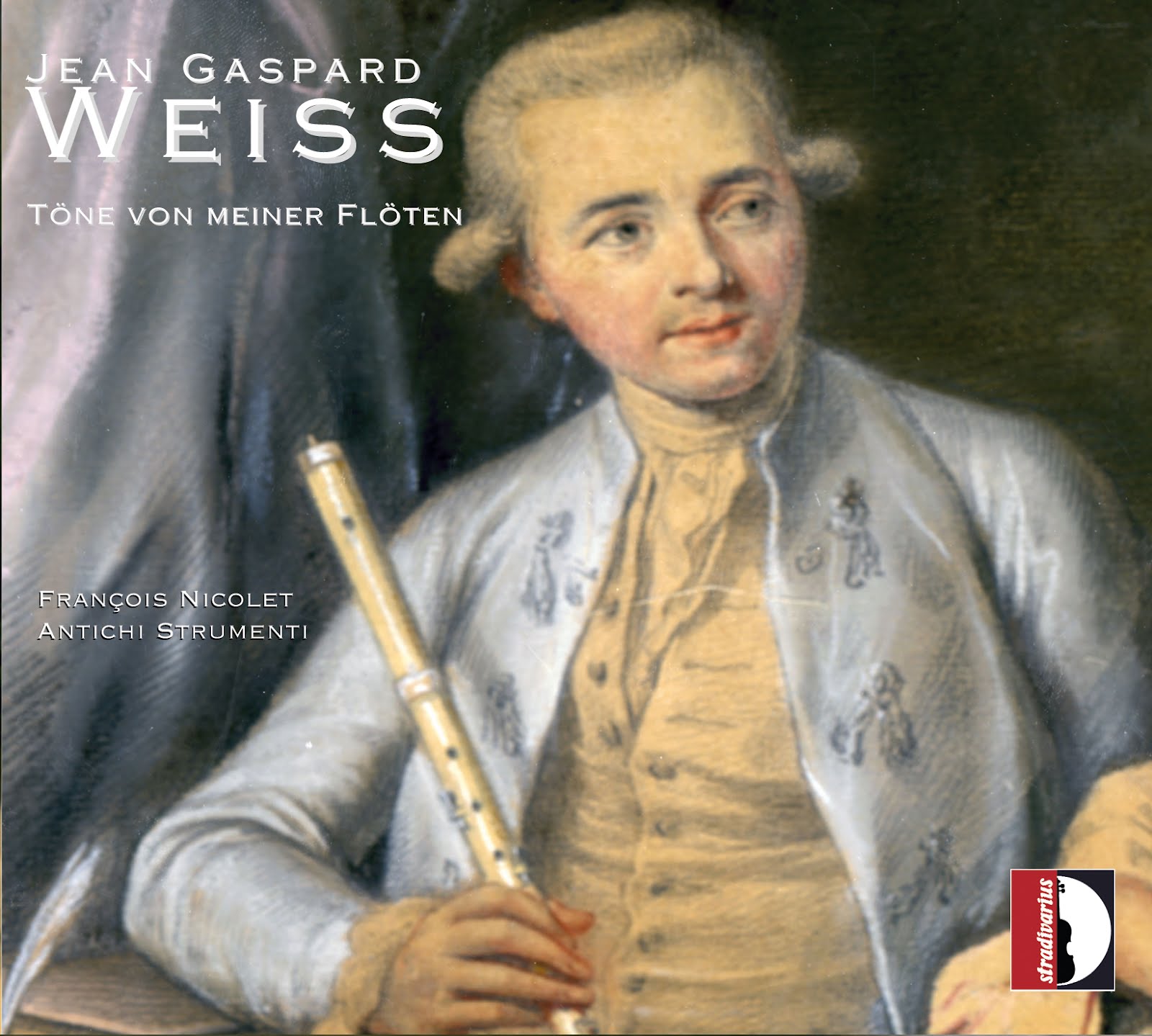
The portrait is below. I have no access to the full artwork in colour, so I'm showing the available partial colour one (from the CD of Weiss's music), plus a black and white image of the full portrait.

According to information on the back of the frame the portrait is thought to have been painted in England in about 1777. Charlotte, the daughter in the photo, was born in June 1776 - the child in the artwork would definitely be around 1 or 2 years old (though how they managed to get her to sit still for a portrait is beyond me!) which fits well with that date.

Would Gaspard Weiss have moved in circles which might have allowed him to sit for a portrait with such a well known artist? In a word, yes. Weiss had patrons, students and acquaintances who would have had contact with Reynolds. Through Lord Abingdon, who was one of his students, he became acquainted with Lord Cholmondeley (who also became a student) and Lord Wentworth. Weiss dedicated flute compositions to all three of these men. Reynolds had painted Lord Cholmondeley as well as portraits of members of both Lord Cholmondeley's and Lord Wenthworth's families. Additionally, Angelika Kauffmann, who had bewitched Weiss in his younger years, became very good friends with Sir Joshua Reynolds upon her arrival in London. It is possible that any of these people could have made an introduction for Weiss with Sir Joshua Reynolds.

Did Reynolds actually use pastels? Jeffares in his Dictionary of Pastellists before 1800 (Online edition) observes that Reynolds did not seem to like using pastels, but then goes on to give details of his pastel works, though many of them appear to have been studies for oil artworks. The only image of a Reynolds pastel that I can find online is Head and Bust of a Woman (see below), held by the National Gallery of Art, Washington D.C., which in comparison is a very simple work, though it happens to be done in similar colours to the portrait of the Weiss family. Comparing the two, it certainly isn't inconceivable that the same artist might have done both - there is something about the way the eyes are worked that is quite similar.

To compare other artworks of Sir Joshua Reynolds completed around the same time, there are a lot more options to consider.

Reynolds' portrait of Charlotte Grenville, wife of Sir Watkins Williams Wynn and her children (above), held by the National Museum Cardiff, is an oil, completed around 1778. It shows Lady Charlotte reclining with a book, while three of her children play at her feet. Lady Charlotte and Marie Weiss share a similar bored, unseeing gaze (to my mind anyway), and even their profiles appear similar. There is drapery hanging from the lefthand side in both paintings also.

The above portrait The Strawberry Girl, from The Wallace Collection, is an oil completed around 1772-3. While the overall tone of the painting is a lot darker than the Weiss family portrait, the lighting on the actual subject is similar - how the shadows fall etc.

Diana Sackville is an oil, completed in 1777, held by the Henry E Huntington Art Gallery. Despite the completely different background for the two paintings, the colour palettes are similar, as is the lighting.

So I've picked out some of Reynolds' paintings which definitely show some similarities, but it wouldn't be a proper assessment if I didn't compare the Weiss family portrait with the work of some of Reynold's contemporaries. I chosen the major portraitists of the day, including Thomas Gainsborough, Sir Thomas Lawrence and George Romney. George Romney wasn't working in pastels during the period the Weiss family portrait was painted, so we can count him out straight away. Thomas Gainsborough did use pastels, but most of his pastel works have not survived as he apparently didn't fix them.

Gainsborough's pastel portrait of Caroline, 4th Duchess of Marlborough, completed in the 1780s, while beautiful, is of a completely different style to Reynolds' Weiss family portrait. It is done much more in the style of a sketch drawing rather than a painting, with quite a bit of hatching. The colour palette is also very different, with the duchess being rendered in a very white/grey palette, giving her an almost ghostlike appearance.

Sir Thomas Lawrence's pastel portrait of Dr Banks Esq, completed in 1784 is also a very different style to that of Reynolds', and to be honest, is much more amateurish - Lawrence was quite young still in 1784.

So, although it is not an entirely comprehensive study of English portrait painters in the 1800s, I am quite content to consider that the pastel portrait of Gaspard Weiss, his wife Marie, and their infant daughter Charlotte was actually done by Sir Joshua Reynolds. If you are more of an expert on these things than me I'd love to hear your opinion!

06 April 2014

How I am related to the embroidery thread company DMC

My sister and I are accomplished embroiderers, and I have been aware for some time that there was a good chance we were related in some extremely distant way to the founders of the embroidery thread company DMC. Last night my sister and I were talking about it, and she challenged me to work out exactly how we were related. I thought it would take ages. Happily it didn't!

DMC (Dollfus Mieg and Company) is a company that was founded in Mulhouse in 1746 by Jean-Henri Dollfus, an artist, Jean-Jacques Schmalzer and Samuel Koechlin, both businessmen. When it was founded the company was known as Koechlin, Schmalzer and Company. It was run jointly by Jean-Henri and his brother Jean Dollfus, and towards the end of the century Jean's son Daniel took over running the company. Daniel Dollfus married Anne-Marie Mieg in 1800, and added his wife's surname to his own, to become Daniel Dollfus Mieg. The company was given the new trading name of Dollfus Mieg and Company - D.M.C.

So how am I related to DMC? Jean-Henri Dollfus, one of the company founders, was the great grandfather of the wife of my first cousin 5x removed. To put it in a way that is hopefully slightly easier to comprehend, Jean-Henri's great granddaughter Sophie-Louise Dollfus married Médard Baumgarten, who was the nephew of my 4x great grandfather Gaspard Weiss.

So every time I sit down to sew with some DMC threads I will now be able to bask in the glow of my familial relationship to the company that made the threads!

11 March 2014

Gaspard Weiss was married twice!

It had been right there under my nose (in his autobiography, though in my defence it is in German and French), but it was only the other day that I realised that my 4x great grandfather (Jean) Gaspard Weiss remarried after the death of his first wife (my 4x great grandmother) Marie Baumgarten.

On 25 November 1800, two years after the death of his first wife Marie, Gaspard Weiss married Judith Risler, daughter of Jean Risler and Marguerite Lauttenbourg, in Mulhouse. She was aged 59, he was 61. Unsurprisingly at their age, Gaspard and Judith produced no children. They were together until Gaspard's death in 1815. It's nice to think he had someone to share his life with again after the death of Marie.

Edited on 22 March 2014 to add:
I found a copy of the marriage certificate today in the Archives Départementales Du Haut-Rhin, and although it is handwritten, in French, I've worked out that his brother-in-law Paul Blech (married to his late wife Marie's sister Lucinda Worrall Baumgarten) was one of the witnesses. It would be interesting to know if other Baumgartens had attended the wedding, apart from Lucinda. Of course, I'll never know that!

The other interesting thing I noted was that Gaspard signed the marriage certificate using German script, using the German variation of his name - Caspar Weiß. I have only ever seen him sign his name as Gaspar(d) Weiss before, quite legibly in normal English-style lettering. I wonder if after Mulhouse reunited with France in 1798 whether he became "more German" and emphasised his German heritage. Below is a comparison of his signatures, the first from his marriage to Marie Baumgarten ("Gaspar Weiss", aged 36), the second on the death certificate of Marie ("Gaspard Weiss", aged 59), and the third at his marriage to Judith Risler ("Caspar Weiß", aged 61). If I didn't know it was definitely him I would dismiss the third signature as by a totally different person!

19 March 2013

The baptism of Mary Baumgarten

I've been searching for some kind of birth/baptism record for Mary (Marie) Baumgarten, daughter of Samuel Christian Frederick Baumgarten (c1729-1798) and Mary Joynes (c1729-?), who was later the wife of Gaspard Weiss (1739-1815), for ages now.

I have a record (from the Burgerbuch of Mulhouse) which suggests that unlike all her siblings who were apparently born in London, England, she was from Nassau-Usingen (though perhaps not born there). I still was looking for some vital records for proof of this though. According to the marriage allegation for Gaspard Weiss and herself, she was born around 1755.

In the last week or so, Findmypast has released 3 million new Westminster records onto their website. I'd previously found lots of records for Baumgartens and Joynes and other related families in Westminster so I did some searching and hit pay-dirt! A "Mary Baumgarten" was baptised at St Margaret Westminster on 15 August 1755. She was recorded as the daughter of "Saml. Christian Frederick by Mary", born 21 July 1755. Mary's sister Charlotte was baptised in the same parish in 1757.

So the question is: was she born in Nassau-Usingen or England? I don't think there's likely to be a way to ever know that for sure, as I've never found any shipping records from that time, which could tell us that a (newborn?) Mary Baumgarten travelled with her parents across the English Channel to England... It does seem possible that there might have been enough time for them to get from Nassau-Usingen on 21 July to London on 15 August though. We'll probably never know...

10 March 2013

Who was the rich uncle?

Reading through the autobiography of Gaspard Weiss today I rediscovered something intriguing that I had read once before.

"Les enfants Baumgarten avaient hérite d'un oncle chacun environ £1500, soit 36000 francs. Cette ennuyeuse affaire, si importante pour les hommes de droit qui me réclamèrent 51 Guinées, retarda notre mariage jusqu'au mois d'août; de plus, par contrat, nous nous engagions, au cas où je retournerais dans mon pays, de placer ce capital en Angleterre au nom de mes enfants. M. Baumgarten vit au bout de quelque temps que cette clause était injuste et il fit tout ce qu'il put pour la faire modifier, afin que cet argent nous fût rendu." Weiss (2012).

Roughly translated, it says that each of the children of Samuel and Mary Baumgarten (née Joynes) inherited £1500 after one of their uncles died, and it was right before Gaspard Weiss and Marie Baumgarten were married in 1775. I'm pretty sure £1500 was a large amount then (the National Archives UK's currency calculator puts it at a value of £95500 in 2005's money), and considering at least four of them made it to adulthood (out of eleven children in total) that's a substantial amount of money to be passing on at the uncle's death.

On the paternal side I only know the date of death of one of Samuel Baumgarten's brothers - John Henry, who died in 1770. Having read his will, he left all his money to his siblings and not to nieces and nephews. I don't know of the wealth of any of Samuel's other brothers nor when they died. I do, however, suspect that the uncle in question lived in England, of which none of Samuel's other brothers did.

Of Mary Joynes' brothers, Bartholomew, Samuel, Thomas and Henry, I assume Bartholomew and Henry died young (likely in childhood) as they weren't mentioned in their father Henry Joynes' will - written in 1754, Thomas died at age 28 (1750), when he probably wouldn't have had time to amass a large fortune, but Samuel was a prominent lawyer who worked in the Middle Temple and had a number of high profile and/or high society clients. He certainly could have left a fortune of the magnitude left to the Baumgarten children. According to his will, Samuel Joynes, after divvying up most of his belongings amongst friends and family, left the remainder in equal shares to his sister's children - Mary and Samuel Baumgarten's children.

Samuel Joynes died on June 10, 1770, which fits with the uncle in question dying before 1775 when Marie Baumgarten and Gaspard Weiss married. So I don't know for certain, but I believe it was Samuel Joynes who left £1500 to Marie Baumgarten.


26 September 2012

James Hunter, engraver of Chester

James Hunter was the father-in-law of my 4x great uncle Willoughby Gaspard Weiss, who was married to James' daughter Ann.

James was born about 1752, possibly in Chester, Cheshire, England. He was presumably married to Jane, the mother of his children, though I haven't yet found a marriage record. I have found records for the births of seven children, two boys and five girls. Ann, my 4x great aunt, was the sixth child and fourth daughter. There are large gaps in years between some of the children so I expect there may well have been more that I can't find records for.

James Hunter was an engraver who lived and worked in Chester, mostly around the Chester Cathedral - in Eastgate St, Northgate St, Werburghs Church-yard. Historical directories also list him as a carver, gilder and copperplate printer. In about 1815 Hunter had rooms with the miniature painter Albin R Burt, who made a coloured engraving of him (which apparently is dated 1830 - that this is after Hunter's death is interesting - perhaps the date is wrong, or perhaps it took Burt a while to get around to finishing it).

A couple of James Hunter's engravings are held in the Cheshire Archives, interestingly, both of them maps. One is a "1789 Survey of the Ancient & Loyal City of Chester", surveyed by Samuel Weston and engraved and published by Hunter. The archives record notes that Hunter "was a prominent local citizen and verger of the Cathedral. His premises, "Hunter Engravers", are marked on the plan at the top of Werburgh's Lane." The other engraving is a "Map of the estates of the Dean and Chapter in and around Chester" from 1812, which includes the previous item and an additional piece apparently drawn by Hunter.

As mentioned above, James Hunter was the verger of the Chester Cathedral for many years from at least as early as 1812 until his death on 18 December 1826. His death notice in the Liverpool Mercury (29 Dec 1826) records: "On Monday, the 18th instant, at Chester, Mr. Hunter, engraver; a man respected and beloved by an extensive circle of friends and relations."

It would appear that James Hunter did not have a son who worked in the family engraving business. Instead, his two spinster daughters Elizabeth (1778-1864) and Catherine (1803-1860) took over the business on his death. Later on they seem to have given up the engraving business and instead became librarians, Elizabeth being the City Librarian in Chester, and Catherine her assistant.

James Hunter gave his name to Hunter's Passage, which was later widened and has been known as Hunter Street since the 1890s. Quite something to be immortalised in a street name!

11 September 2012

Adelaide Weiss/White/Sheldon

I've been researching Charles and Benigna Weiss' son Egmont and decided to plug "Weiss" into the India Births/Baptisms, Marriages, Deaths/Burials collections of FamilySearch. I was surprised to find a record for Adelaide Martha Weiss, aged 17, daughter of Charles Nicholas Weiss, marrying Patrick White, aged 32, son of Patrick White, in Bombay on 12 Oct 1846.

Huh? Adelaide Weiss, firstborn child of Charles Nicholas and Benigna Catherine Weiss, was married to James Sheldon, a Church Missionary Society missionary, and they had at least five children together. And so she was, and so they did, but in fact she was married to Patrick White first.

And that explains why I have never been able to find a marriage record for Adelaide and James - because Adelaide's surname was not Weiss but White when she married him.

The family story goes that the family was in India and when the children of Charles and Benigna Weiss were orphaned, after their parents died in quick succession in 1845, the boys stayed in India and went to military school, and the girls returned home to England. That their firstborn daughter Adelaide married Patrick White in India, only a year after the death of her remaining parent, her mother, suggests that Adelaide may not have returned to England, but in fact stayed in India.

Adelaide married at 17 to a man almost twice her age. Although this was probably more common then than it is today it is tempting to wonder if it was a marriage of convenience, in order to provide her siblings with some stability and security in India. I have not found any evidence of children being produced by the marriage. When Patrick died on 26 April 1853 (information from FIBIS and the Glasgow Herald of 20 May 1853) at age 39 Adelaide was only 23. Adelaide's sister Caroline was definitely in India during this time - she married Henry Richard Hughes in Bombay in 1851. Her brother Frederick was definitely in India from 1850 until September 1853 when he returned to England - I have copies of some of his own notes which state this.

Perhaps after her husband Patrick died Adelaide did go back to England for a time, but she turned up again in Bombay, India, on 9 July 1861, marrying her second husband James Sheldon, who was a CMS missionary in Karachi. James and Adelaide were the same age, and I find it easier to imagine that they married for love rather than convenience.

04 August 2012

Some missing details filled in

Recently, when I discovered that the second child of Charles Nicholas and Benigna Catherine Weiss was actually a boy named Bernard James George, as opposed to a girl named Benigna as was previously thought, I contacted the British Library Asian and African Reference Service to see if they were able to locate parish records for Bernard's baptism. They found the baptism record, and because his sister Caroline Judith (child number three) was baptised on the same day, they offered me both. Yes please!

So in the mail the other day I received a transcript of the baptisms of Bernard and Caroline. And the information I was really hoping for was there - their actual dates of birth!

Bernard James George Weiss was born on April 15, 1831, and Caroline Judith Weiss was born on 5 February 1833. The place of their births was not noted, however, from newspaper advertisements of the time which were either placed by their father, or were for concerts in which their father was performing, I believe the family was most likely living in Liverpool at the time. In fact, according to those advertisements, at the time of Caroline's birth they were living in 3 Camden Street, Liverpool. Unfortunately I cannot pinpoint Bernard's birthplace in the same way.

So that's another couple of missing details filled in!

16 July 2012

Bernard (not Benigna) Weiss

I recently bought a subscription to findmypast, as I have so many English ancestors it seemed like it could be worth it. So far I've found an awful lot more information. Today I stumbled upon a record alluding to one of Charles Nicholas and Benigna Catharine Weiss' children: the second child, who we've always assumed was a girl called Benigna, born about 1831.

Why have we assumed she was called Benigna? Good question. We know that the second child's name started with "B" because Charles and Benigna followed the alphabet in naming their six children - A through to F. However there is nothing official stating that the second child's name was actually Benigna - perhaps this was an assumption because "her" mother's name was Benigna. And why do we think she was a girl? No idea!

The records in question on findmypast are the Armed Forces BMD Details. Charles Nicholas Weiss went to India with the British Army in 1840, in the 17th Foot Regiment. I have records for the two youngest children, Egmont and Frederick, being baptised in Aden (now in Yemen, then part of British India). I also have a baptism record for the eldest child, Adelaide, in England, before the family left for India. Which leaves three more - children B, C and D.

The Armed Forces BMD records show four baptisms for the surname of Weiss:

Name Place Year Regt.
Weiss, Bernard J. G. Poona 1831 17th
----- Caroline J. Poona 1833 17th
----- Egmont J.T. Aden 1837 17th
----- Frederic A. Aden 1839 17th

Caroline J, Egmont J.T. and Frederic A. are all definitely children of Charles and Benigna Weiss. The years given are the years they were born, not the years they were baptised. Considering the year of birth for Bernard Weiss matches the B child of Charles and Benigna's, and the father of Bernard Weiss was also in the 17th Foot Regiment (and Weiss was an extremely uncommon name at the time in England), the chances of there being a second British Army member with the surname of Weiss stationed in Poona (now known as Pune) and in the same regiment as Charles, is highly unlikely.

So now we have definite details of the B child of Charles and Benigna Weiss - the child was male, his name was Bernard J.G. Weiss, and he was born in 1831. We must assume he was born in England as the family was living in either Liverpool or Manchester in 1831. I wonder if the "J.G." stood for Jean Gaspard, after his paternal grandfather?

We still haven't much on the D child - "Derby" according to the 1841 English Census - which, incidentally, Bernard wasn't recorded in. Considering Derby was still alive in 1841, presumably close to the time the rest of the family followed Charles to India (who arrived there in 1840), he either died before they left for India, or whilst they were in India, but before he was baptised with the others. Still not sure why the kids baptised in British India were done in two lots, one lot in Poona, the other in Aden...

Edited to add: I received an email from the British Library India Office in reply to an enquiry I sent them which confirmed that Bernard James George Weiss was baptised in Poona on 27 December 1840, along with his sister Caroline Judith Weiss. This suggests that the family may well have travelled to India at the same time as Charles, not later after the 1841 Census, as I had originally thought. That Bernard is not in the 1841 Census suggests that he may have died by that stage. I still don't know when or where Derby was baptised, considering he was in the 1841 Census when Bernard wasn't...

24 June 2012

A CD of Gaspard Weiss' music

A new CD has just been released by Stradivarius of my great great great great grandfather Gaspard Weiss' music. This is the first CD ever dedicated solely to Weiss' music. I have ordered a number of copies from Tobias Bonz of Antichi Strumenti, the ensemble who performed on the CD. I can't wait to get my very own copy and play it!

Should you be interested, you can listen to excerpts of the tracks here. I didn't expect that I would like it so much! Not being hugely learned in music, I was envisaging something like Jane Rutter's flute music, which really does nothing for me. However, the German flute played in the pieces sounds, to my ear, a whole lot more like a recorder than today's flute. Plus, I do like that era of music. I recommend it wholeheartedly. Beautiful, beautiful.

The CD is available from Stradivarius, Antichi Strumenti and on iTunes.

15 June 2012

An engraving of Charles Nicholas Weiss

I borrowed something precious from my great aunt on the weekend. She has in her possession an engraving of Charles Nicholas Weiss. I scanned it, and present it below.


The caption is "Charles N. Weiss. Engraved by F. McCabe from a Drawing by Charles Hayter. London"

Charles Hayter (1761-2 December 1835) was an English artist who specialised in portrait miniatures. He was appointed as a Professor of Perspective and Drawing to Princess Charlotte, daughter of King George IV.

There is very little information available on the engraver McCabe, however I believe he was also known as E.F. McCabe and worked in the 1820s. Two of his engravings are held by the British Museum.

If this engraving was done in the 1820s Weiss would have been about 30-something. The most obvious feature on his face is the hooked nose. Interestingly, my late great aunt, Weiss' great granddaughter, had the same shaped nose.

Edited on 16 June 2012 to add:
It suddenly occurred to me to ask my great aunt what she had known about the subject of the engraving. I rang her this morning and asked her. Her father had believed it was of his grandfather (correct). Family legend said that Charles Nicholas Weiss had gone through three fortunes in his lifetime (possibly correct - who knows?!), and her father was of the understanding that he was "pretty musical" (correct). So despite the family not really having any idea of the fame that Charles Nicholas Weiss had in his day for his flute playing, clearly a little information filtered through, down the generations. My great aunt said that they used to have it framed and hanging on the wall, and then it was put into an album. I'm glad she realised it was important enough to keep!

26 May 2012

Gaspard Weiss and J.C. Bach

In an article on my 4x great grandfather Gaspard Weiss (1739-1815) in Sortir à Mulhouse (which appears to be a newsletter on some sort of cultural program for Mulhouse - its in French so I'm not completely sure!), number 36, a reference is made to him being one of the musicians who interpreted Amor Vincitore before King George III. I tried to find information on this a while back but was unsuccessful.

I've just come across a new reference to this in "Clarinet in the Classical Period" by Albert R. Rice (2008). Amor Vincitore was a cantata by Johann Christian Bach - youngest son of Johann Sebastian Bach. Rice writes that two movements of the piece have solo parts which were written for four virtuosos - Karl Weiss (flute), Johann Christian Fischer (oboe), Josef Beer (clarinet) and Georg Wenzel Ritter (bassoon). "Karl" was a German form of the French name "Gaspard", and there are other references to Gaspard Weiss as "Karl Weiss". Gaspard Weiss often worked with the oboist Fischer. Rice also says that in 1774 Amor Vincitore was performed in Carlisle House in London (on April 15), at a benefit concert for Fischer, and at a private performance for the royal family. Obviously if you were having your new cantata performed for the royal family you would make sure it was being performed by the musicians it was written for - hence we know that Weiss almost undoubtably did play for King George III.

I still have no definitive proof that Gaspard Weiss was the principal flautist for King George III as claimed by his son Charles Nicholas Weiss, in his letter to the music dictionary publisher John Sainsbury. Perhaps if the claim was an embellishment of the truth, this may have been the event Charles was referring to.

25 May 2012

A little more information on Willoughby Gaspard Weiss

Trawling through Google Books today I discovered some new information on Willoughby Gaspard Weiss, son of (Jean) Gaspard Weiss, brother of Charles Nicholas Weiss, and my 4x great uncle.

The Gentleman's Magazine of 1867, volume 223, page 828, notes the following information regarding Willoughby Gaspard's son Willoughby Hunter Weiss, famous opera singer: "He was the eldest son of the late Gaspard Weiss, esq., of Liverpool and Manheim (sic)..." This is the first time I have definitely seen Willoughby Gaspard Weiss referred to as Gaspard Weiss i.e. without the "Willoughby", which Tobias Bonz and I have previously had discussions over - he believes there are references to Gaspard Weiss which refer to Willoughby Gaspard Weiss, but this is the first time I have seen it without a doubt.

The other new bit of information is the connection to Mannheim, Germany. Previously I have found references to a W G Weiss importing goods into Liverpool from Germany:
Liverpool Mercury, 7 May 1830: "1 case merchandise".
Liverpool Mercury, 15 October 1830: "1 ch [chest?] musical instruments".
Liverpool Mercury, 15 May 1835: "1 [something - I can't work out exactly what!]"
Liverpool Mercury, 7 September 1838: "1 case musical instruments".

All of the imports came through the port of Hamburg, however Mannheim could have been where he was importing them from. There were flute makers in Mannheim in the 19th century, so it is quite possible that there were flutes amongst the musical instruments that Weiss was importing. I have searched and searched but can't find anything else relating to Weiss and Mannheim. If only there was a search engine for German historical newspapers!