24 June 2012

A CD of Gaspard Weiss' music

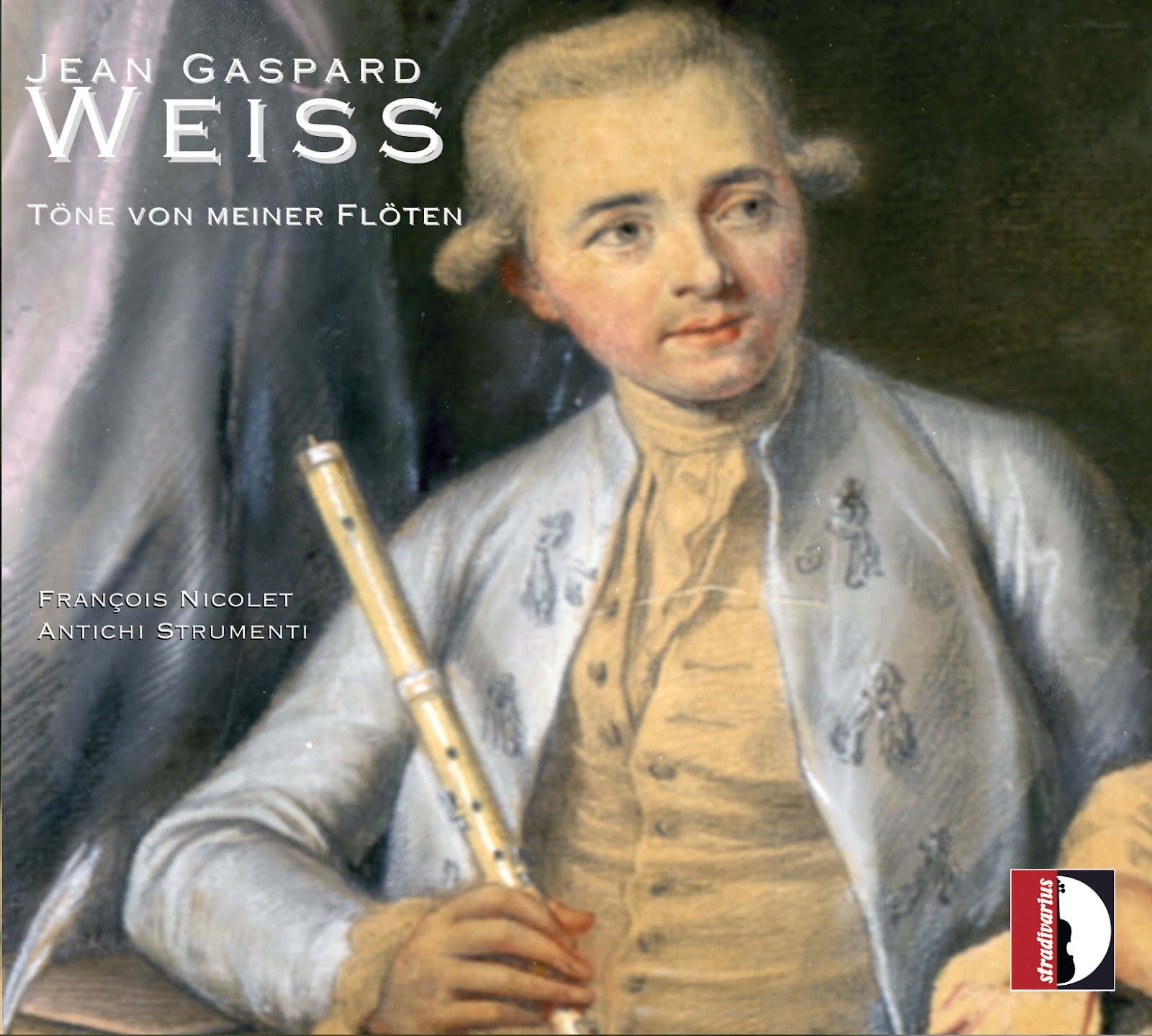
A new CD has just been released by Stradivarius of my great great great great grandfather Gaspard Weiss' music. This is the first CD ever dedicated solely to Weiss' music. I have ordered a number of copies from Tobias Bonz of Antichi Strumenti, the ensemble who performed on the CD. I can't wait to get my very own copy and play it!

Should you be interested, you can listen to excerpts of the tracks here. I didn't expect that I would like it so much! Not being hugely learned in music, I was envisaging something like Jane Rutter's flute music, which really does nothing for me. However, the German flute played in the pieces sounds, to my ear, a whole lot more like a recorder than today's flute. Plus, I do like that era of music. I recommend it wholeheartedly. Beautiful, beautiful.

The CD is available from Stradivarius, Antichi Strumenti and on iTunes.

21 June 2012

Sarah Horsey, greengrocer

Carole from Heritage Genealogy posted on council rates assessment books the other day, and I was totally unaware that they were available. Both the City of Sydney Council Rates Assessment books 1845-1948 (transcriptions and images) and the Newtown Rates and Assessments 1863-1892 (transcriptions) are available online.

Looking up some of my ancestors, I knew that Josiah Horsey worked as a corn and hay dealer in George Street, Sydney, and also owned a fruit shop in Hunter Street, so I started off with him. He and his wife Sarah are listed a number of times.

Year Name of ratepayer Name of building owner Address Building type Building description Annual Value
1855 Josiah Horsey Samuel Oakley 499 George St House Wood and shingle, 1 floor, 3 rooms £50
1856 Josiah Horsey Saml Oakley 499 George St House Wood and shingle, 1 floor, 3 rooms £50
1861 Josiah Horsey John Woods 46 Hunter St House and shop Brick and galvanised iron, 1 floor, 2 rooms £60
1867 Sarah Horsey John Woods 46 Hunter St House and shop Brick and shingle, 1 floor, 4 rooms, out of repair £76
1877 Sarah Horsey D Clarkson 183 Liverpool St House Brick and iron, 1 floor, 4 rooms £50
1880 Sarah Horsey Thomas Buckland 183 Liverpool St Shop Wood and iron, 2 floors, 6 rooms £72

Correlating this with entries in the Sands Directories I found the following:

Josiah was working as a fruiterer/greengrocer at 46 Hunter Street from around 1861 until (presumably) his death in 1863. His wife Sarah then took over the business and stayed at 46 Hunter Street until at least 1869, even though the conditions of the building were clearly deteriorating. We then have a gap of almost 10 years where Sarah apparently disappears and then she pops up again in 1877 at 183 Liverpool Street, once again as a fruiterer, though 1879's Sands Directory describes her as a dealer - presumably the shop had morphed into a "mixed business". By 1880 (the year Sarah died) the business was obviously doing well enough to have taken on quite a bit more of the building, with 2 floors and 6 rooms instead of 1 floor and 4 rooms. Or possibly extra space was taken up by Sarah and Josiah's youngest son, Josiah jnr, who was listed in 1880 at the same address as a hay, corn and produce dealer, the same occupation his father once had.

As for the missing years for Sarah, I've searched and searched and searched. I wondered if she might have ended up in the clink for some reason, though there's no evidence of that. There are a few clues in Trove though.

In December 1864 a Sarah Horsey, greengrocer, was convicted of having light weights in her barrow, which she used as a stall, and she was fined 20s plus costs. Although I am aware that there was another Sarah Horsey in Sydney at around the same time - the other was convicted of habitual drunkenness after my 3x great grandmother had died, there is nothing to suggest the other Sarah Horsey was a greengrocer like my relative was. So I think this probably was my Sarah Horsey. It would appear from the fact that she was using a barrow as a fruit stall that she had given up the shop in Hunter Street. Despite her inheritance from Josiah's estate, had she fallen on hard times?

In October 1873 a lost and found notice appeared in the Sydney Morning Herald, for a missing milking cow, advising enquirers to apply to Mrs Horsey, fruit shop, Lyons Terrace. Lyons Terrace was a series of elegant terrace houses in Liverpool Street, opposite Hyde Park. Knowing that Sarah lived and worked at 183 Liverpool Street, a look at Google Maps showed that address was itself opposite Hyde Park. Other advertisements in the Sydney Morning Herald show that there was a fruit shop in Lyons Terrace as early as 1868, although there is no evidence that Sarah owned or managed it at that time. So I think she was probably still working as a greengrocer/fruiterer during the missing years, though where she actually lived, with her children, for some of that time is a mystery. (And as an aside, thinking of Hyde Park today, I do find it amusing to imagine a lost milking cow wandering around the park!)

There is one other reference in the Sydney Morning Herald to a Sarah Horsey that is notable: in November 1876 a Sarah Horsey was fined 20s by the Inspector of Nuisances for allowing unwholesome matter to remain on her premises. Although it does not give an address for this Sarah Horsey, it may have been that she was selling bad fruit or vegetables from her fruit shop, if it was her.

15 June 2012

An engraving of Charles Nicholas Weiss

I borrowed something precious from my great aunt on the weekend. She has in her possession an engraving of Charles Nicholas Weiss. I scanned it, and present it below.


The caption is "Charles N. Weiss. Engraved by F. McCabe from a Drawing by Charles Hayter. London"

Charles Hayter (1761-2 December 1835) was an English artist who specialised in portrait miniatures. He was appointed as a Professor of Perspective and Drawing to Princess Charlotte, daughter of King George IV.

There is very little information available on the engraver McCabe, however I believe he was also known as E.F. McCabe and worked in the 1820s. Two of his engravings are held by the British Museum.

If this engraving was done in the 1820s Weiss would have been about 30-something. The most obvious feature on his face is the hooked nose. Interestingly, my late great aunt, Weiss' great granddaughter, had the same shaped nose.

Edited on 16 June 2012 to add:
It suddenly occurred to me to ask my great aunt what she had known about the subject of the engraving. I rang her this morning and asked her. Her father had believed it was of his grandfather (correct). Family legend said that Charles Nicholas Weiss had gone through three fortunes in his lifetime (possibly correct - who knows?!), and her father was of the understanding that he was "pretty musical" (correct). So despite the family not really having any idea of the fame that Charles Nicholas Weiss had in his day for his flute playing, clearly a little information filtered through, down the generations. My great aunt said that they used to have it framed and hanging on the wall, and then it was put into an album. I'm glad she realised it was important enough to keep!

08 June 2012

William Baumgarten

Samuel Baumgarten (born c1729, died 1798), bassoonist, and his wife Mary (born and died ?) had at least 11 children. I previously have mentioned the three daughters, Marie, Charlotte and Lucinda, whom I have been able to trace further than their baptisms here. Marie was my great great great great grandmother, married to Gaspard Weiss. Although they married in England, Marie and Gaspard moved to Mulhouse, France in about 1783. Marie died in Mulhouse 16 April 1798.

I was looking at Lucinda again yesterday, as the marriage record of her daughter is available to view on FamilySearch. Lucinda Worrall Baumgarten, like her sister Marie, moved to Mulhouse. She married Paul Blech in Mulhouse on 12 November 1787. They had at least three children, one of whom was Lucinde. Lucinde Blech married Auguste Debaute on 9 April 1831 in an unknown French protestant church. I took some time to study the names signed under the marriage record entry, presumably the happy couple, the minister and some witnesses. The names included: Auguste Debaute (the groom), Lucinde Blech (the bride), H Glück, Z? Engel, Laure Glück, Marie Heilmann, Le Lieutenant Gen.al B? ??? (can't read it all, but very intriguing!), [squiggle] Baumgarten, ? Debautes, S. Baumgarten Dollfus, Julie Roederer, ? Roederer, David Roederer, J. Kohler and P. Heilmann.

It was the Baumgarten surnames that caught my eye. Although the mother of the bride's surname was Baumgarten (Lucinda) and also her aunt's (Marie), I didn't expect to see any Baumgartens there, unless a male member of the Baumgarten family had come across from England too.

Googling "Baumgarten" and "Mulhouse" revealed a number of Mulhouse-related genealogy websites, mostly the same ones that come up when searching for "Weiss" and "Mulhouse". And I found a William Baumgarten who married an Anne Catherine Schlumberger, but the most telling point was that William Baumgarten was "l'époux est originaire de Londres (Grande-Bretagne)" - he was originally from London, Great Britain, and was also born in approximately 1762. Marie, Lucinda and Charlotte Baumgarten had a brother William who was born around 1764 (at least, that's when he was baptised).

A search on Gallica revealed a couple of references to a William Baumgarten of London in a cartulary for the Schlumberger family, including one which noted that he had a personal fortune of 36000 livres (a lot of money). So where did his fortune come from? I have found no references to him back in England. Was it an inheritance, from his father? Could his father, a professional bassoonist and bassoon teacher have possibly earned enough to leave an inheritance like that to one of his children?

Looking for other Baumgartens on FamilySearch in the same collection as the marriage record for Auguste Debaute and Lucinde Blech (France, Protestant Church Records, 1612-1906), I came across an entry which referred to a Baumgarten and a Schlumberger - "Guillaume Baumgarten" and "Catherine Schlumberger." Guillaume is the French version of William, plus its definitely possible that an Anne Catherine might go by her second name... Looking at the actual record (a marriage record for Guillaume and Catherine's son Médard) it recorded the place of birth of Médard as Mulhouse. Bingo! So I think we can assume that William/Guillaume Baumgarten moved to Mulhouse from London, and was most likely the brother of Mulhouse residents Marie Weiss née Baumgarten and Lucinda Blech née Baumgarten.

The final two things I was curious about were (a) which of the Baumgarten siblings arrived in Mulhouse first, and (b) considering we don't know where Samuel Baumgarten was born, was it likely that they were returning to their father's birthplace?

Gaspard Weiss returned to Mulhouse with his wife Marie and their children in 1783. Both Lucinda and William were married in Mulhouse, France in 1787 - Lucinda on 12 Nov 1787, and William on 9 May 1787. It suggests to me that Marie arrived in Mulhouse first, William and Lucinda followed at some stage, met people, fell in love, married and stayed. As for whether Samuel Baumgarten originally came from Mulhouse, I can't find any records of Baumgartens in Mulhouse going back as far as his reputed dated of birth, so it's unlikely.
01 June 2012

Thomas Wickham, butcher of Margate, Kent

I was contacted by a descendant of Thomas and Rachel Wickham yesterday, seeking more information about the family, which got me searching a little further. It goes to show, send me an email and I might do some research you are interested in!

I have previously written about Thomas Wickham (1811-1897), the patriarch of the Australian branch of my Wickham family here and here. I was searching for information on him or his children on FamilySearch today and discovered three entries for the birth of his firstborn son Thomas (1836-1911). One entry, under "England, Births and Christenings, 1538-1975" just gives his date of birth, the other two are from the "England and Wales, Non-Conformist Record Indexes (RG4-8)", one of which gives his birthplace as No 7 Market St, Margate, Kent, the other gives it as Cripplegate, London. I think the reason for the discrepancy here is because Cripplegate is where Dr William's Library is, which is where the records for some of the non-conformist churches (Baptist, Congregational and Presbyterian) were held (they are now held by the UK National Archives).

This is interesting on two points. The first is that the Wickhams clearly attended a non-conformist church, though of which variety I have no idea. Unfortunately I have not been able to find definite birth records for any of Thomas and Rachel's other children, which may or may not have helped me to narrow it down. I do know, however, that Thomas and Rachel's son Robert Wickham was married to Annie Jane Smith by the minister of the Waterloo Congregational Church (Sydney). So perhaps the Wickhams were Congregationalists.

The second reason why this is interesting is because it names the actual place Thomas Wickham jnr. was born (in 1836) - 7 Market St Margate. Google Street View shows that the building currently at that location houses a Chinese restaurant! A search of historical directories shows Thomas Wickham, butcher, at 6 Market St, Margate in the Pigots Directory of 1840. I have found no other references to the Wickham's place of work or residence in Margate anywhere else. I don't know if 6 and 7 Margate St were beside each other or roughly opposite, but looking at the buildings in the street now, it is my guess that the Wickhams lived in the same building as the butcher shop. Perhaps Thomas jnr was born in a neighbour's house (someone who could help first-time-mother Rachel through the labour?) or perhaps they moved within the same street. I think the former option is more likely.

26 May 2012

Gaspard Weiss and J.C. Bach

In an article on my 4x great grandfather Gaspard Weiss (1739-1815) in Sortir à Mulhouse (which appears to be a newsletter on some sort of cultural program for Mulhouse - its in French so I'm not completely sure!), number 36, a reference is made to him being one of the musicians who interpreted Amor Vincitore before King George III. I tried to find information on this a while back but was unsuccessful.

I've just come across a new reference to this in "Clarinet in the Classical Period" by Albert R. Rice (2008). Amor Vincitore was a cantata by Johann Christian Bach - youngest son of Johann Sebastian Bach. Rice writes that two movements of the piece have solo parts which were written for four virtuosos - Karl Weiss (flute), Johann Christian Fischer (oboe), Josef Beer (clarinet) and Georg Wenzel Ritter (bassoon). "Karl" was a German form of the French name "Gaspard", and there are other references to Gaspard Weiss as "Karl Weiss". Gaspard Weiss often worked with the oboist Fischer. Rice also says that in 1774 Amor Vincitore was performed in Carlisle House in London (on April 15), at a benefit concert for Fischer, and at a private performance for the royal family. Obviously if you were having your new cantata performed for the royal family you would make sure it was being performed by the musicians it was written for - hence we know that Weiss almost undoubtably did play for King George III.

I still have no definitive proof that Gaspard Weiss was the principal flautist for King George III as claimed by his son Charles Nicholas Weiss, in his letter to the music dictionary publisher John Sainsbury. Perhaps if the claim was an embellishment of the truth, this may have been the event Charles was referring to.

25 May 2012

A little more information on Willoughby Gaspard Weiss

Trawling through Google Books today I discovered some new information on Willoughby Gaspard Weiss, son of (Jean) Gaspard Weiss, brother of Charles Nicholas Weiss, and my 4x great uncle.

The Gentleman's Magazine of 1867, volume 223, page 828, notes the following information regarding Willoughby Gaspard's son Willoughby Hunter Weiss, famous opera singer: "He was the eldest son of the late Gaspard Weiss, esq., of Liverpool and Manheim (sic)..." This is the first time I have definitely seen Willoughby Gaspard Weiss referred to as Gaspard Weiss i.e. without the "Willoughby", which Tobias Bonz and I have previously had discussions over - he believes there are references to Gaspard Weiss which refer to Willoughby Gaspard Weiss, but this is the first time I have seen it without a doubt.

The other new bit of information is the connection to Mannheim, Germany. Previously I have found references to a W G Weiss importing goods into Liverpool from Germany:
Liverpool Mercury, 7 May 1830: "1 case merchandise".
Liverpool Mercury, 15 October 1830: "1 ch [chest?] musical instruments".
Liverpool Mercury, 15 May 1835: "1 [something - I can't work out exactly what!]"
Liverpool Mercury, 7 September 1838: "1 case musical instruments".

All of the imports came through the port of Hamburg, however Mannheim could have been where he was importing them from. There were flute makers in Mannheim in the 19th century, so it is quite possible that there were flutes amongst the musical instruments that Weiss was importing. I have searched and searched but can't find anything else relating to Weiss and Mannheim. If only there was a search engine for German historical newspapers!

23 May 2012

The Beringer Bros Winery family

Once again, I will state right here that I have no evidence currently that I am related to the Beringer Bros Winery Beringer family. However, I am interested in them because their German background has been very hazy until now, so here I am to set the record straight.

As I wrote recently, Jacob and Frederick Beringer of the Beringer Bros Winery in Napa Valley were reputed to have been born in Mainz, Germany. I tracked down baptism records for them in St Quintin's Catholic Church, Mainz, and as I had some of my own Beringers baptised in the same church (Valtin and Dorothea Beringer, my 3x great grandfather and his sister), I ordered the microfilm of the records in to my local LDS Family History Centre.

Of the six known children in Jacob and Frederick's family, three of their baptism records were in the St Quintin's register - Jacob F, Frederick and Conrad's. I think the other three - Carl, Jacob H and Werner - were baptised at the Catholic Cathedral in Mainz.

Published information about the family has always suggested that Jacob and Frederick's father Conrad Ludovic Beringer was in the wine trade, but the baptism records state that he was a bookbinder. He must have been a reasonably well-off bookbinder to be able to send Frederick to school in Paris...

Further searching revealed that Conrad Ludovic's father was named Friderick and his mother Elisabetha Bergern/Bergin. Conrad had at least one brother, Werner (born about 1798, baptised at St Quintin's on 12 December 1798). Although I have seen Werner's baptism record, unfortunately it does not note what his father Friderick's occupation was. I have found some references to Werner possibly being a bookbinder as well, with an advertisement in Rheinische Blätter on 5 October 1816 announcing a Werner Beringer as a book and paper handler in the Schustergasse (now known as Schusterstraße) Mainz. It does suggest to me that if potentially two of his sons were in the book trade, Friderick may also have been.

So that's a little more about the family of Jacob and Frederick Beringer, who founded the Beringer Bros Winery in Napa Valley, California. And I still haven't found any connection to my Beringers.

15 May 2012

Thomas Ball

Thomas Ball was my great great great great grandfather. He is something of an enigma.

Thomas Ball was born about 1790, apparently in Highgate, Middlesex (according to his details in the 1871 Census). His parents are unknown.

On May 25 1812 at the age of 22 Thomas married Sarah Preston by banns at St Mary church, Hornsey, in the borough of Islington. They both signed their names. Thomas and Sarah were both living in the parish of Hornsey at the time of their marriage. There are two children who are definitely known from the marriage: James and Eleanor. James and Eleanor were both baptised on 23 November 1817 at St Mary Mounthaw. There are two parish records available for that parish, one of which gives the birth dates of the children. James' birthday was 12 December 1812. A very short gestation?! (Interestingly, the family records said he was born in 1814 - this would have been much more acceptable, except that it was wrong!) Eleanor was born 17 June 1817. At the date of the children's baptisms the family was living at Old Fish Street Hill, London, and Thomas, aged 27, was working as a corn porter. A corn porter worked on the docks, usually shifting sacks of corn onto or off ships. It would have been hard, menial work.

In 1837 Thomas' daughter Eleanor was married. In the marriage register Thomas was noted as a greengrocer.

The next definite record I have for Thomas is from his son James' immigration record in 1857 - he and Sarah were noted as living in Fenchurch St, London.

In the 1871 Census Thomas was widowed and living at Francis Cottage, Highgate. There was no rank, profession or occupation listed.

Thomas Ball died on 12 January 1873 at his residence, Francis Cottage. According to a death notice his son James placed in the Sydney Morning Herald (15 Mar 1873) Thomas worked "for nearly twenty-five years in the establishment of Charles Rivington Esq., Fenchurch St, London, solicitor, to the Hon. E.I.C." I had originally assumed that this meant that he had been employed by Charles Rivington until his death, but looking at his places of residence, I suspect that he may have retired some time prior to his death. To live in Highgate and work in Fenchurch St, London would have been quite a hike! I wonder what Thomas did for Charles Rivington - that he worked in "the establishment of Charles Rivington Esq." suggests that he was employed in the business in some way, but that he and Sarah lived on the premises (in 1857) suggests alternately that he might have been household staff. He certainly wasn't still hauling sacks of corn around!

It is interesting that although Charles Rivington was a solicitor, he came from a family of book publishers who were well connected with the Stationers' Company. Thomas' son James became a bookbinder, and was supposedly made a City Freeman, which was in some cases closely related to livery companies such as the Stationers' Company. One wonders if this was (a) how James got into the book trade, and (b) a connection that made his becoming a City Freeman possible. Also, Thomas' daughter Eleanor married a solicitor's clerk, John Bache Downing. Did they meet through Thomas' work?

I have tried to find records for Thomas (and Sarah) in the 1841, 1851 and 1861 Censuses, but have no definite records for them. I wish I knew where they were hiding!

03 May 2012

Kissing Cousins

William Rich (c1832-1927) was my great great grandfather. I am descended from his daughter Christina (1889-1971), who was born to his second wife Lavinia Huxley (1847-1929). Previously, William was married to his first cousin Mary Jane Bindon (1838-1872). In Australia it is legal to marry your first cousin, though whether it is a good idea to have children is another thing, considering the limited gene pool. However, the genetic implications of having children with your first cousin were unknown in those days and so William and Mary Jane had a number of children. I'm not sure of the exact number as the records do not really agree with each other on the names. The one thing I do know is that none of the children survived childhood.

William H Rich was their firstborn, and was born on July 22 1861 in Peel River, NSW. He died sometime in 1862 - I haven't gotten around to getting a transcript of his death certificate. Until the other day I had not found any concrete evidence of William and Mary Jane having any more children and assumed that they had not. I have wondered whether William H's short life span was just related to the type of illness which took many people's lives in those days before the advent of antibiotics, or whether there had been a congenital condition which had led to his death.

The other day a distant relative contacted me and pointed me in the direction of some children born to William and Mary Jane in Victoria, and further research revealed more, born in (surprisingly) New Zealand. I was completely unaware the family had spent time in New Zealand.

Other children believed to have been born to William and Mary Jane Rich:
Emma (born ?, died 1868 in New Zealand)
Sampson (born ? and died pre-1872)
Henry Bindon (born 1865, New Zealand - died 1865, New Zealand)
Sydney (born 1865, New Zealand - died 1866, New Zealand)
Alfred (born 1868, New Zealand - died 7 Dec 1872, Melbourne)
Cornelia (born 1870, New Zealand - died 21 Nov 1872, Melbourne)
Avice (1872, Melbourne - 2 Jul 1872, Melbourne)

Avice's death certificate says she was born in Hokitika, New Zealand. This is actually incorrect - there is a record of her birth in Victoria, however, as both her parents were not with her when she died it's not surprising that there was a mistake. However, it does suggest where the family were in New Zealand. William Rich was working on the gold fields at Peel River, NSW, before they went to NZ. Hokitika was settled in the 1860s after gold was found there. A huge number of Australians went there for the ensuing gold rush, apparently William Rich and his family included. Exactly when they arrived in NZ is unknown, but they returned to Australia, to Melbourne, in 1872. Had William made his fortune? Who knows.

The story of the children who died in Melbourne is terribly sad. Their mother Mary Jane died in Melbourne on 8 April 1872. William was left with three children, Alfred, aged 4, Cornelia, 1 3/4 and Avice, aged only 21 days old. William apparently was unable to care for the three of them, presumably because he needed to work, and fathers didn't do that sort of thing in those days anyway, so they were put into care. All three of them were sent to Industrial Schools, which were for the care of neglected children. Albert died in the industrial school on December 7, 1872 of bronchitis and whooping cough. Cornelia died November 21, 1872 of debility and marasmus (extreme malnutrition), and Avice on July 2, 1872 of marasmus and apoplexy. The industrial schools cannot have been happy places to live, especially considering the two girls died of extreme malnutrition. Were these children destined to die young anyway because of congenital conditions? We'll never know, because there was no knowledge of those things then, but it is a possibility, particularly in the case of Cornelia, who died of debility and marasmus.

It is interesting to note that from William's second marriage, to Lavinia Huxley (who was not a blood relation of his), of their eight children, none of them died in childhood.