19 March 2013

The baptism of Mary Baumgarten

I've been searching for some kind of birth/baptism record for Mary (Marie) Baumgarten, daughter of Samuel Christian Frederick Baumgarten (c1729-1798) and Mary Joynes (c1729-?), who was later the wife of Gaspard Weiss (1739-1815), for ages now.

I have a record (from the Burgerbuch of Mulhouse) which suggests that unlike all her siblings who were apparently born in London, England, she was from Nassau-Usingen (though perhaps not born there). I still was looking for some vital records for proof of this though. According to the marriage allegation for Gaspard Weiss and herself, she was born around 1755.

In the last week or so, Findmypast has released 3 million new Westminster records onto their website. I'd previously found lots of records for Baumgartens and Joynes and other related families in Westminster so I did some searching and hit pay-dirt! A "Mary Baumgarten" was baptised at St Margaret Westminster on 15 August 1755. She was recorded as the daughter of "Saml. Christian Frederick by Mary", born 21 July 1755. Mary's sister Charlotte was baptised in the same parish in 1757.

So the question is: was she born in Nassau-Usingen or England? I don't think there's likely to be a way to ever know that for sure, as I've never found any shipping records from that time, which could tell us that a (newborn?) Mary Baumgarten travelled with her parents across the English Channel to England... It does seem possible that there might have been enough time for them to get from Nassau-Usingen on 21 July to London on 15 August though. We'll probably never know...

12 March 2013

A trip to Waverley Cemetery

I recently managed to get to Waverley Cemetery to see some graves there. Waverley is a cemetery with a lovely setting - it is situated on the cliffs at Bronte, in the eastern suburbs of Sydney. It overlooks the Pacific Ocean, so the "guests" there have a great view, if only they weren't so dead that they couldn't enjoy the scenery. There were two lots of graves I wanted to check out - the Rich graves and the Horsey graves.

I started off with the Rich graves. I asked at the office as I had no idea where they were. For a $15 fee (which I think is steep, considering some cemeteries don't charge at all for information, but I guess they have to pay for up-keep somehow) they gave me a whole lot of details about where the graves were, and also offered the family with the chance to take over the lease of the graves as there was still room available. For only about $1700 for a 25 year lease. Otherwise, they may be recycled at some stage in the future - which makes me glad that I photographed them while I had the chance!

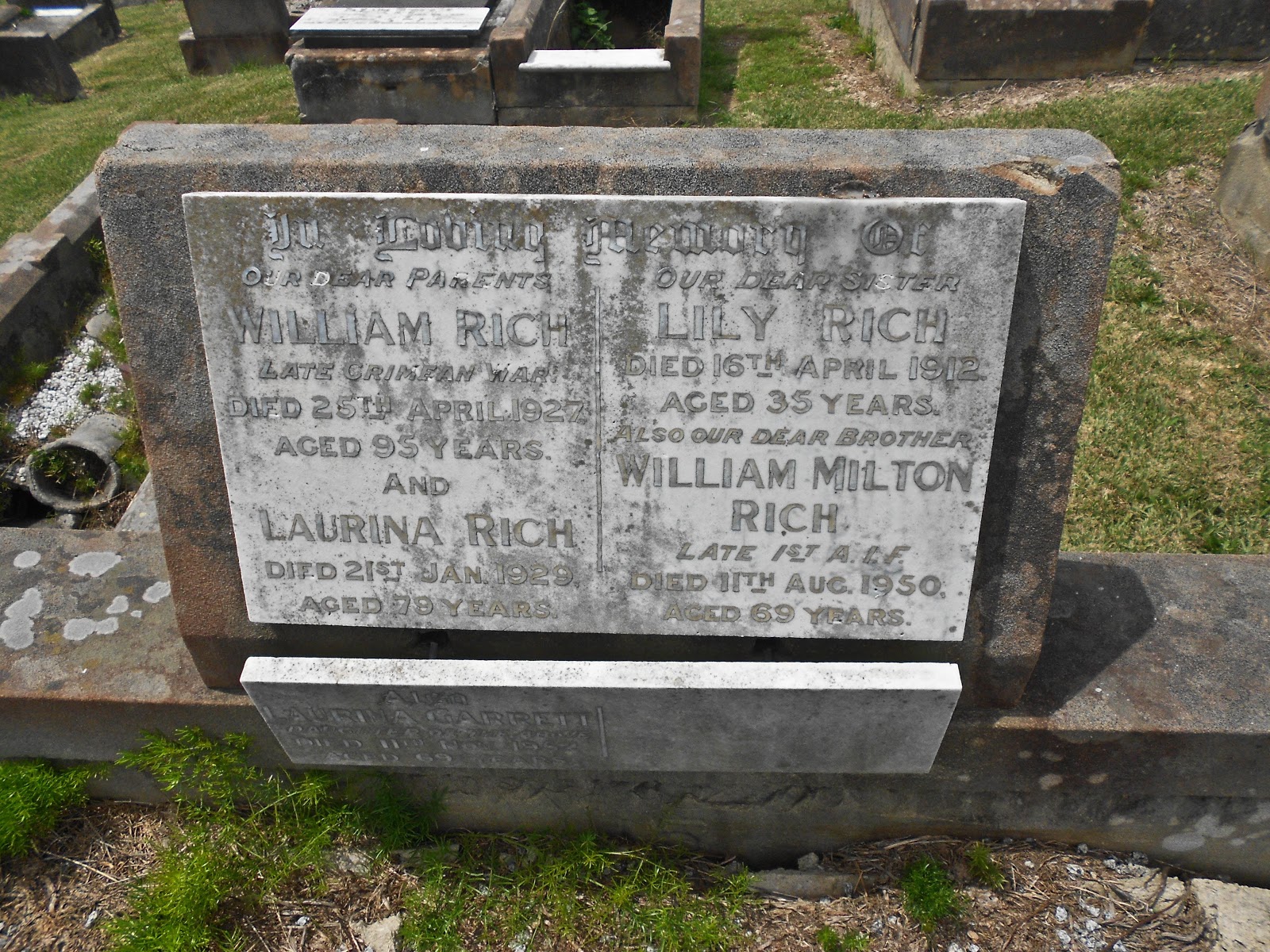
The first photo shows the double grave for the assorted members of the Rich family buried there (Church of England, Section 15 Ordinary, graves 6206 and 6207), along with my little helper. The inscription that my little helper was sitting on said "Erected by Avice", Avice being one of William and Laurina's daughters.

The inscription on the headstone says:
"In Loving Memory of
Our dear parents William Rich, late Crimean War, died 25th April 1927, aged 95 years, and Laurina Rich, died 21st Jan 1929, aged 79 years.
Our dear sister Lily Rich, died 16th April 19112, aged 35 years.
Also our dear brother William Milton Rich, late 1st A.I.F., died 11th Aug 1950, aged 69 years."

On the lower section it says:
"Also Laurina Garrett, daughter of the above [William and Laurina], died 11th Nov 1962, aged 69 years."

Also buried in the grave is Laurina Garrett's husband Maurice, although there is no inscription bearing his name (though there is space for it next to his wife's details - clearly no one ever got around to it). He was buried there 23rd Aug 1956.


This photo is of the grave of Sarah Horsey, and members of her extended family - James and Selina Baker, Charles, Selina Grace and Harriett Eliza Baker, and Frederick and Maria Ruth Horsey. The details of these graves are Church of England, Section 2 Ordinary, Row 10, graves 235-238.
Selina Horsey was Sarah and Josiah Horsey's daughter. She was married to James Baker. James' brother Charles was married to Selina's sister (and Sarah and Josiah's daughter) Sarah Ann, and Selina Grace was their daughter, with Harriett Eliza being Charles' daughter from a previous marriage (his first wife died). Sarah Ann, Charles' wife is not buried in this grave as she remarried after the death of Charles, and so is presumably buried with her second husband elsewhere. Frederick Horsey is a son of Sarah and Josiah Horsey, and was married to Maria Ruth.
  

The inscription on this headstone is:
"In Loving Memory of Sarah Horsey, native of Somersetshire England, who died June 21 1880, aged 64 years.
In such mournful visitation
On this sweet assurance rest
Whatsoever the dispensation
God's decree is always best"

There is definitely space at the bottom of this headstone for details of further burials, but apparently there were none. Josiah, Sarah's husband, was buried in the Devonshire Street Cemetery, which closed in 1867, thus explaining why Sarah wasn't buried there with him. The Devonshire Street Cemetery was  resumed in 1901 to make way for the building of Central Station, but I've never been able to work out where Josiah's remains were moved to. Perhaps he was moved to Waverley and buried with Sarah, but the information never recorded on the headstone. If I was over that way again (it's a bit of drive from my place) with another spare $15 I could get them to look up the burial information for those graves, but as I had what seemed like most of the information at the time I didn't do it on this particular visit.

10 March 2013

Who was the rich uncle?

Reading through the autobiography of Gaspard Weiss today I rediscovered something intriguing that I had read once before.

"Les enfants Baumgarten avaient hérite d'un oncle chacun environ £1500, soit 36000 francs. Cette ennuyeuse affaire, si importante pour les hommes de droit qui me réclamèrent 51 Guinées, retarda notre mariage jusqu'au mois d'août; de plus, par contrat, nous nous engagions, au cas où je retournerais dans mon pays, de placer ce capital en Angleterre au nom de mes enfants. M. Baumgarten vit au bout de quelque temps que cette clause était injuste et il fit tout ce qu'il put pour la faire modifier, afin que cet argent nous fût rendu." Weiss (2012).

Roughly translated, it says that each of the children of Samuel and Mary Baumgarten (née Joynes) inherited £1500 after one of their uncles died, and it was right before Gaspard Weiss and Marie Baumgarten were married in 1775. I'm pretty sure £1500 was a large amount then (the National Archives UK's currency calculator puts it at a value of £95500 in 2005's money), and considering at least four of them made it to adulthood (out of eleven children in total) that's a substantial amount of money to be passing on at the uncle's death.

On the paternal side I only know the date of death of one of Samuel Baumgarten's brothers - John Henry, who died in 1770. Having read his will, he left all his money to his siblings and not to nieces and nephews. I don't know of the wealth of any of Samuel's other brothers nor when they died. I do, however, suspect that the uncle in question lived in England, of which none of Samuel's other brothers did.

Of Mary Joynes' brothers, Bartholomew, Samuel, Thomas and Henry, I assume Bartholomew and Henry died young (likely in childhood) as they weren't mentioned in their father Henry Joynes' will - written in 1754, Thomas died at age 28 (1750), when he probably wouldn't have had time to amass a large fortune, but Samuel was a prominent lawyer who worked in the Middle Temple and had a number of high profile and/or high society clients. He certainly could have left a fortune of the magnitude left to the Baumgarten children. According to his will, Samuel Joynes, after divvying up most of his belongings amongst friends and family, left the remainder in equal shares to his sister's children - Mary and Samuel Baumgarten's children.

Samuel Joynes died on June 10, 1770, which fits with the uncle in question dying before 1775 when Marie Baumgarten and Gaspard Weiss married. So I don't know for certain, but I believe it was Samuel Joynes who left £1500 to Marie Baumgarten.


10 February 2013

Why the Beringers switched from Catholic to Protestant

Yesterday I had a lovely morning meeting five of my Beringer cousins. I worked out our relationship - I am second cousin once removed to them (and them to me), they are all siblings. They are descended from Charles Joseph Wilfred Beringer (their grandfather) and I am descended from Charles' brother Adolf, known as Jim (my great grandfather). We had a great time, sharing photos and stories.

I realised quite some time ago that, way back, my Beringer ancestors were Catholic - back in Germany. I was surprised at this because in my family we are all Protestant and I had assumed that they always had been. However, when I delved into it I found that Adam and Caroline Beringer, my great great grandparents, the ones who emigrated to Australia, were definitely Catholic. But I also knew that pretty much all the next generation had switched to Protestantism. Why?

I knew that their mother Caroline had committed suicide, and that therefore she had not been able to be buried in a Catholic cemetery, and instead was buried in the Presbyterian section at Rookwood Cemetery. Knowing that your beloved mother was not allowed to be buried in her own denomination's cemetery might well have been a reason to reject the denomination you were brought up in, except that I was pretty sure that the children never knew that their mother had committed suicide. So what brought about the change was a mystery to me. I also knew that their father, Adam, had not converted to Protestantism, as he was buried in the Catholic Cemetery at Rookwood, with his second wife, Elizabeth. I believe they also married in a Catholic church. So it was definitely something that caused the children, but not their father, to switch.

And so, yesterday while talking with my cousins, I found out the reason. It all had to do with Adam Beringer's second wife Elizabeth.

My Beringer cousins were talking with great affection about their Auntie Mary, who was the youngest of the Beringer children - she was only one year old when her mother committed suicide. My cousins were brought up Catholic, as their mother Dorothea had married a Catholic. Auntie Mary went along with them to some family event at their church and one of them offered to sit with her and help her through the service. Auntie Mary cheerfully said that she had been brought up a Catholic, so she was very familiar with everything happening. Auntie Mary later explained to them that her family's governess, Miss Elizabeth Gates, who was their father's second wife, was Catholic. She has always been portrayed to me as the archetypal wicked stepmother, which according to Auntie Mary's stories, was completely true. The way she treated all the children was so bad that they all decided that if she was a Catholic and treated them like that, they wanted nothing to do with Catholicism. Apparently her throwing them all out when they turned 14 (after they had finished school) was a mutual thing - the children (independently of her) decided to get out as soon as they had finished school, to get away from her.

It would appear to me that the children's relationship with their stepmother affected their relationship with their father very negatively. I believe that they rarely saw him, but at least some of them had some contact with him. When WW1 broke out Charles Beringer made a statement, now held in the National Archives of Australia under the ASIO files "Depositions of Enemy Subjects in the Public Service", as he was employed by the public service, but had a German surname - apparently it was to prove he wasn't a German sympathiser. In this statement he said "I do not know whether my father is living or dead. I saw him once in Parramatta Park about 8 years ago. He did not know who I was. He was an engineer. The last I heard he was at Merrylands ... just out of Parramatta" (NAA, A387, 43). This statement certainly suggests he was estranged from his father. When George Beringer returned for a 10 day holiday to Australia in 1927 he only visited his father the night before he left, though he spent quite a bit of time with his siblings throughout the visit. Plus there are some photos which exist of an elderly Adam with some of his children and grandchildren, definitely taken after the marriage to the wicked stepmother, though she is conspicuously absent. All this suggests to me that Adam's children had occasional contact with their father after they each left home, but probably as little contact with their stepmother as possible. I wonder if Adam ever realised how much damage his second wife did to his family, or whether he was blinded by love?

23 January 2013

The final resting place of Carolina Friederichs

I've been trying to work out what happened to Carolina Helena Maria Friederichs née von Holst for some time now.

Recently I've been working on the Tourrier branch of the family - Carolina's sister Constantia married a Tourrier, and I'd found that her husband Jean Furcy Tourrier may have been buried in Kensal Green Cemetery.

I sent off a query and hit the jackpot:

Jean Furcy Tourrier was buried in Kensal Green Cemetery in 1867 in grave 20207, square 105, row 10. Also buried in that grave were Constance Tourrier in 1877, Albert Charles Millet in 1878, Alfred Holst Tourrier in 1892, and Caroline Fredericks in 1884.

Constance Tourrier was Jean Furcy Tourrier's wife - baptised as Constantia - with Constance obviously an anglicised version of the name.

Albert Charles Millet was the husband of Ida Sarah Tourrier, one of Jean Furcy and Constantia Tourrier's daughters. I don't know where Ida was buried - she died in 1919, after three of her four children, so perhaps she was buried with at least one of them.

Alfred Holst Tourrier was one of Jean Furcy and Constantia Tourrier's sons. He never married.

Caroline Fredericks was Carolina Helena Maria Friederichs née von Holst. Realising that she might have lived under an anglicised version of her name I searched through the English censuses to see if I could find her. The last time she was listed under the spelling of Friederichs was in the 1851 census. But there she was in the 1871 and 1881 censuses, as Caroline Fredericks. She was noted as widowed, and lived with a servant, or boarded with another family. So she was buried with her sister and some of her sister's family. It suggests to me that her husband, Joachim Friederichs, died overseas, and then she returned to England to live out the rest of her life. I'm glad I finally tracked down where she ended up, and her final resting place.

19 January 2013

The Merrick family of Sligo

I've been contacted by a Merrick relative - my third cousin once removed - so I've been delving into the Merricks back in Ireland again.

William Merrick was my great great great grandfather. William was married to Jane, and they had at least seven children: James (1845-1911, my great great grandfather), Samuel (1849-1913), Anne Jane (1862-?), John Thomas (1864-1959), Mary Ellen (1867-?), William (dates unknown, but apparently died as a child), and Esther (dates unknown). Considering the early children were born around the time of the Irish potato famine, I can't imagine life would have been easy for the Merricks in those early years of their family.

I don't know when William Merrick was born or died, or even who his parents were, but he certainly lived in Sligo, County Sligo, Ireland during his life. The first address I have the Merricks living at was in 1845, recorded on son James' baptism record, in Ramseys Row, with William noted as a shoemaker. On the baptism of son Samuel, in 1849, and in 1862, at the baptism of daughter Anne Jane, the family was in Williams St, and William was again noted as a shoemaker. In 1858 William Merrick was noted in the Griffiths Land Valuations as occupying a house, office and garden of 17 perches on the south side of Georges St, Town of Sligo. There is also another record, the same year, for a William Merrick occupying land (no buildings) of just over one acre in Derrydarragh or Oakfield, Parish of St Johns, but I'm not sure that this is him. Again in 1867 the family was living in Georges St, at the time of daughter Mary Ellen's baptism. In 1870 William was listed in the Slaters Directory as a shoemaker, and also as the keeper of the Fire Engine Station, in John St, Sligo. William was also the village sexton at the time they lived in John St, apparently in the Sexton's House. I have found reference to the fire engine being kept on the premises next door to the sexton's house in John St, as the vestry was responsible for the repair and upkeep of the engine, being a public service. This certainly fits with William being both the keeper of the engine and the village sexton.

James and Samuel followed their father into shoemaking and emigrated to Australia. John Thomas was a carpenter and also emigrated to Australia. Both Anne Jane and Mary Ellen married. Esther also married but has also gone down in a corner of literary history. Apparently the Merricks were neighbours of the Yeats family. In his childhood the famous poet William Butler Yeats was taught spelling by Esther Merrick and she also took it upon herself to read poetry to him. Yeats' father later said it was Esther Merrick who made a poet out of young William, though he was kind enough not to credit her with his son's appalling spelling!

And that is about all that is known for certain of my Merrick family in Sligo. There were plenty of other Merricks in Sligo. My Merricks were Protestant though there were some in Sligo who were Catholic. Interestingly, a Samuel Merrick was the sexton in Colry (Calry) parish, Co. Sligo in 1860 - possibly a relation. I'm sure there were lots of Merrick relations in Co. Sligo, I just haven't been able to straighten out all the relationships!

04 January 2013

Jean Furcy Tourrier

Jean Furcy Tourrier was born in about 1799, apparently in Paris, France. He arrived in England some time before 1830, when he first advertised French classes:

METHODE-JACOTOT. - The great success that Mr. Jacotot's Method meets with on the Continent has induced Monsieur TOURRIER, Professor of French and Drawing, not only to give it a serious study, but to try it in one of his establishments, and from the rapid improvement, especially in the pronunciation, he no longer hesitates to adopt it, and intends forming CLASSES, either at home or abroad. He will form on the 15th of August an evening class in the city. Mr. Tourrier has in the press a Treatise, in which he will display verbatim la methode Jacotot. Apply at 41 Great Portland Street, Portland Place, on Mondays and Thursdays, till 12 o'clock; or at Mr. Price's 7 Cateaton Street. The Times, 2 Aug 1830, Issue 14294, p.2.
He married Constantia Eleonora von Holst at St Pancras Old, St Pancras, London, on 20 June 1833. Jean was about 34 years of age, Constantia 28 years old.

As well as teaching French, Jean Furcy Tourrier also wrote many books about learning French, the first one published in 1830, the last one in the 1860s, and many are held by the British Library. He was apparently known in France for teaching in London using the Jacotot method - a method of teaching languages devised by Joseph Jacotot. Jean Furcy Tourrier apparently built up quite a good career in London and taught at many different colleges (such as the Westminster School - apparently for 14 years, London Academy of Music, Cavendish College, Northumberland College for Ladies, and Notting Hill College for Ladies). He also taught day and evening classes in many locations across London (e.g. Islington, Highgate, Notting Hill, Kensington, Hammersmith, Richmond, plus his own residence) and offered private lessons, both in London and abroad.

Evidently a claim to fame, according to the introductory pages of a number of his publications, Jean Furcy Tourrier was French Master at Westminster School for 14 years, and reader to HRH Princess Sophia. I puzzled over this idea of being a "reader" to a princess for a day or two (what did it mean?) until I remembered something I had read about Princess Sophia - she was blind for over ten years before her death. Perhaps he was simply her reader - someone who read things to her because she herself could not. How he might have landed a job like that is an interesting question!

Jean Furcy Tourrier was also an artist and taught drawing. As far as I know, none of his works have survived. I have found that he exhibited a fair number of works in the exhibitions of the Royal Academy in 1838, 1839, 1843, 1845 and 1846. All the works were landscapes, most of them entered in the Drawing and Miniature category - I suspect they were all drawings. Two of his sons were also artists - Turban Holst Alfred Tourrier (known as Alfred Holst Tourrier, many of his works have survived) and Gustave Leon Furcy Tourrier (apparently not as well known or prolific as his brother). Both the sons painted in oils, though I'm sure their father would have given them a good foundation in drawing.

Jean Furcy Tourrier also seemed to be a bit of an inventor, and twice registered petitions for patents for wildly different ideas. The first, with his petition registered on 16 February 1859, was for the invention of "preventing oscillation of the last carriage of a railway train, and giving rigidity and steadiness throughout the train" (London Gazette, Issue 22236, p.1012). The second, the petition registered on 21 January 1862, was for the invention of "an improved method of, and apparatus for, warning adjoining houses by means of air chambers attached to grates in the party walls dividing houses" (London Gazette, Issue 22596 p.667). It makes me imagine him sitting at home, or on the train, thinking, dreaming up new ways to make things better.

Although Jean Furcy Tourrier was from France, it is possible he had a sister living in London at least for a time as well. Louise Aglaée Tourrier married Louis Charles Emiland Manneville at St Anne's Soho, Westminster on 16 December 1827. Louis was himself born in England, but possibly his parents were both French (Louis Athanase Manneville and Catherine Jauvet). Louise was born in France - I have seen a record of her arrival in England, returning after 5 years away, from Boulogne in France, and she is recorded as a native of France, her occupation "Lady". I have nothing concrete to prove this assumption that she is Jean Furcy Tourrier's sister, apart from the fact that the dates are similar, and a variation of her middle name was used for one of Jean and Constantia's daughters - Georgiana Eleonora Aglae Tourrier.

Jean Furcy Tourrier died on 26 January 1867, aged 68, and was buried in Kensal Green. He apparently worked right up until his death, as the Northumberland College for Ladies was still advertising him as their French teacher a week before his death.

01 January 2013

2012 - The year in review

I had thought that this past year hadn't been quite as successful as the previous one based on exciting finds, but in reviewing all my work for this post, I'm not so sure that's correct. True, there haven't been as many well-known/famous people popping up in the family tree, but I've still found out huge amounts, but with a lot more hard slog.

I thought for my review of this past year's research I would focus on the most useful resources I've used. Not the ones that anyone can plug a search into and find info - like Ancestry or Findmypast, but the ones where it takes much more patience, but in the end can be so much more rewarding because you discover a titbit of information which no one else has known about perhaps since the time the relevant person and their close relatives died.

I love research and have no problem trawling for hours through parish records or newspaper articles to find useful information. Often it involves the use of Google Translator to translate things from French or German, but that's just more of the fun! So here are the most useful resources that I've used this year for finding obscure bits of family history information:

FamilySearch microfilms
I am enormously grateful to Pauleen Cass for putting me onto this wonderful resource. Although on FamilySearch you are able to search for records online, the Church of the Latter Day Saints has microfilmed thousands, possibly millions, of parish records from across the world, which you can borrow for a limited time for a small fee, and access through your local Family History Centre. You can find the records available for borrowing through their catalogue search. Through this service I have searched through many for baptism, marriage and burial records for lots of Beringers this year, as well as some of the Baumgartens in Germany. There is no way I could have accessed all of those as easily if I were trawling through the same records in the local archives in Germany. Here, I can take down the information, go home and translate it, and then go back for more when I know who else to look for. As well as the vital records I also checked out a merchant navy record for someone who turned out to not be a relative. Looking through parish records takes a lot of patience, especially when they are written in other languages, but you can find out so much that you just can't get anywhere else.

Gallica
Gallica is a search engine for French documents. Although you can choose to have the search page in English rather than French, the results are in whatever language the document was published in - most often French. From Gallica I have, over time, found an awful lot of information about the Weiss' and my research this year on William Baumgarten was definitely aided by Gallica. Usually when I use Gallica, I find any articles which appear to reference the person I am interested in (because I can't read French), then type the relevant paragraph(s) into Google Translator to work out if they actually are about the person I am researching. It's a slow painstaking process, but can be quite rewarding.

British Newspapers 1600-1900 (Gale)
These British newspapers are what I return to time and again when I am researching my English and Scottish relatives. As a resident of NSW I am eligible to be a member of the State Library of NSW, and in their e-resources I have access to this database (through a password), from the comfort of my own home. If your relative won any "biggest turnip" competitions at the local fair, got in trouble with the law, had possessions stolen, played in the local cricket team, advertised their business, etc, there's a chance they got their name in the paper. Once again it is a slow painstaking process checking through sometimes hundreds of articles to see if any of them actually refer to your own relative, but you can find some gems. I have found lots of references to my musical relatives importing instruments, advertising music lessons, their latest published music, or write ups of concerts they were in. If the felt they were important enough (or rather had the money to pay for it) they might also have placed birth, death or marriage notices. However I also have many other relatives who seemed to keep their heads down, out of mischief and never rated a mention. It can be a real mixed bag.

UK National Archives Documents Online
The UK National Archives can be a goldmine of information - well what would you expect?! Through their catalogue you can search all collections or just online collections. With the online collections, for a small fee you can download the document straight away. It is very useful for wills and military records. The family line that I myself have traced back the furthest - the Peisleys in the 1600s (through the Weiss', Baumgartens and Joynes) - it was mainly because of information in wills that led me back so far, as the parish records that far back don't contain much useful family history information. Be prepared to decipher difficult handwriting.

So there's my top options for finding obscure information about your ancestors. Happy 2013!

27 December 2012

Mademoiselle Leonora Tourrier

This particular bit of research was prompted because two Australian Tourrier relatives contacted me quite recently. So I thought I'd do a bit more Tourrier investigation for them!

Georgiana Eleonora Aglae Tourrier was born in Marylebone, London, England, on 19 December 1844 to Jean Furcy and Constantia Eleonora Tourrier (née von Holst), the third youngest of (by my count) ten children.

She was baptised at All Souls Church Marylebone on 12 July 1846. She was noted in the 1851 English Census as living at 69 Charlotte Street, Marylebone, with her parents, and a sister, two brothers and two servants.

I have not been able to find the Tourrier family in the 1861 Census. Perhaps they were in France visiting relatives - Jean Furcy Tourrier was born in Paris.

The next we hear of Leonora, as she was often called, was in a periodical article about a musical soirée to inaugurate the opening of the "Young Ladies College" in Regents Park in January 1865 (The Orchestra Musical Review, No. 70, 28 Nov 1865, p.279). "Mdlle. Tourrier", as one of the soloists, was to sing a cavatina "La Sonnambula" by Bellini and a song "Leggiero Invisible" by Arditi.

It would seem that Leonora made a small career out of singing before her marriage. In November 1867 she was a vocal soloist at a pianoforte recital at Westbourne Hall, Westbourne Park, Westminster (The Orchestra Musical Review, No. 216, 16 Nov 1867, p.117). In December of the same year she performed in a second recital at the same place, and was encored in her performance of a serenade (The Orchestra Musical Review, No. 221, 21 Dec 1867, p.196). She also sang at a concert in the Beethoven Rooms in July 1868, and at the inauguration of a new branch of the Marylebone Penny Readings in Paddington Green in February 1869. In June 1869, as a pupil of Madame Therese Leupold (well known in musical circles in those days), she performed some classical songs at a musical soirée of Mme Leupold's. "The singing of Madlle. Tourrier in Glück's "Chè farò," was in every respect excellent... the duet, "Voga tonio," by Madlle. Tourrier and Miss Goodall, and two vocal trios, in which the above mentioned ladies were joined by Miss Ogle, were received, as they deserved to be, with the most spontaneous applause." The Musical Times, 1 July 1869, p.148.

By 1874 Leonora was married, to Anthony Charles Montague Jellicoe, a former soldier in India, China and the Cape of Good Hope. They were married at St Matthew's Brixton, Leonora aged 29 and Anthony 33. Anthony was listed as a "Gent", and they both lived in Acre Lane - and at a guess they lived together - they had four children together, all boys, with their first child born two years before they married.

I do wonder what calibre of "Gentleman" Anthony Jellicoe actually was - he was made bankrupt in 1866 and apparently spent time in the Debtor's Prison, he got Leonora pregnant before they were married, and eventually, when he died in 1895, he left all his money (£300) to some spinster named Annie White even though he was still married to Leonora!

Anyway, Leonora lived out her days with her sons (at least for some of the time), until her death in the fourth quarter of 1923, her death registered in Brentford, Middlesex.

14 December 2012

Samuel Wickham, butcher of Linton

Samuel Wickham (born about 1749, died ?) was my 5x great grandfather. Samuel was baptised at St Peters Tunbridge (also known as Tonbridge), Kent, England on 17 May 1749. His parents were Samuel Wickham and Ann Humphery. My research shows that Samuel was the youngest of six children, though there may well be other children I haven't uncovered, but all the known children were baptised in Tunbridge.

Samuel married Ann Duddy, from Hunton, on 16 November 1776 by licence. Samuel, a bachelor, was noted as a butcher in the village of Linton, and Ann was a spinster.

Samuel and Ann had six children all presumably born and definitely baptised in Linton - Rebecca (born about 1777, baptised 10 Aug, 1777), Thomas (my 4x great grandfather, born about 1778, baptised 27 Dec 1778), Samuel (born about 1780, baptised 14 Aug 1780), Edward (born about 1782, baptised 10 Feb 1782, buried 24 Feb 1782), Ann (born about 1783, baptised 4 Apr 1783), and Mary (born about 1784, baptised 14 Jul 1784, buried 4 Sep 1784).

Samuel's wife Ann died in Dec 1784, and was buried in the St Marys Hunton churchyard on 17 December 1784.

What happened to Samuel then is a matter of guesswork. I have found a marriage (by licence) record for a Samuel Wickham and a Mary Duddy in Lambeth, London, on 25 May 1785. Both Samuel and Mary are noted as living in the parish of Lambeth St Mary, and tellingly, Samuel is a widower. If this is my Samuel, the fact that he married a woman with the same surname as his late wife suggests she may well be a relative, perhaps Ann's sister.

I have also found a record for a child named John Wickham, born to Mary Duddy and "Wickham" (no first name noted), who was baptised in Hunton, Kent in 1785.

So if this is my Samuel Wickham, marrying his sister-in-law, or at least his late wife's relative, I wonder what they were doing in Lambeth, London? Did baby John come before or after the wedding? That they married in London and later returned to the Linton-Hunton area suggests to me that perhaps John was conceived before they were married, they went to London to hide the pregnancy from the locals of Linton-Hunton, then returned, married, with a new baby. I'd be interested to know where Samuel's other children were while all this went on. Of course, this is all my guesses - I don't know for sure that it was my Samuel Wickham, but I suspect it was.

As for when he died, there are many family trees on Ancestry which suggest he died in 1802, but I can find no evidence for this.