Showing posts with label The Macindoes. Show all posts

06 July 2016

Walter McIndoe part 2

I'm still trying to sort out Walter McIndoe. I truly suspect that the Walter McIndoe born to Robert McIndoe and Bethia Duncan in Strathblane, Stirlingshire on 7th July 1763 is NOT the Walter McIndoe who lived and worked on Ladrishmore Farm, Kilmaronock, Dunbartonshire.

The Parish of Strathblane and its inhabitants (Smith, 1886) states on page 46 that "Walter McIndoe, son of Robert McIndoe and nephew of James McIndoe, last [laird] of Carbeth, was a merchant in Virginia, US, and died unmarried." 

According to A Dictionary of Scottish Immigrants to the USA (Whyte, 2009, p286), Walter McIndoe, nephew of James McIndoe of Carbeth, Stirlingshire, settled in Petersburg, Virginia, before 1821, and worked as a merchant. 

Walter McIndoe is listed for Petersburg in the Personal/Property Tax Lists for 1790 and 1799. As a result of the American Revolution a Loyalist Claim was placed by a W. McIndoe in Virginia in 1806 - it wouldn't be unheard of for a Scot to side with the British Crown. Walter McIndoe was still living in Petersburg, Dinwiddie County, Virginia, in the 1830 US Census, but no longer there by the 1840 Census, presumably because he died during that decade. Although none of these particular records  confirm this Walter McIndoe is Scottish, it all certainly fits in the timeline.

So, I am willing to provisionally accept that Walter McIndoe, son of Robert McIndoe and Bethia Duncan, did emigrate to America, and therefore that Walter McIndoe of Ladrishmore Farm is not the son of Robert McIndoe and Bethia Duncan. 

So this means I need to make some adjustments to my family tree, and find new parents for Walter McIndoe of Ladrishmore Farm. I'm not expecting it to be easy!

22 June 2016

Walter McIndoe

I've never really done a lot of research on the MacIndoe/McIndoe family in Scotland, because I am aware of so many others who have done the research already. However, I've been going through my family tree, checking info, just to make sure there is enough evidence, in my mind, for these people.

And I've come across Walter McIndoe, my 4x great grandfather, who was married to Jean Andrew, and lived in Dunbartonshire, but was supposedly born in Strathblane, Stirlingshire, to Robert McIndoe and Bethia Duncan, on 7 July 1763. Jean Andrew was allegedly born in New or East Kilpatrick, Dunbartonshire, to William Andrew and Jean Reid on 7 August 1761.

However, I want evidence. I can't find a marriage record for Walter and Jean, which might have given me further information on where Walter was from (though quite possibly not). I also can't find a death record, nor any will which might list brothers and sisters and where they live, and thus show any links to Strathblane.

The children of Walter and Jean that I have found records for are in the table below (with some large variations on the spelling of the surname!):

Date Name Parents Location
23 Jan 1784 Jean Walter McIndoe, Jean Andrew Cloberhill
28 Apr 1789 Margaret Walter McAndue, Jean Andrew Ladrishmore
10 Sep 1791 Walter Walter McAndue, Jean Andrew Ladrishmore
14 Sep 1793 Walter Walter MacIndoe, Jean Andrew Ladrishmore
12 Feb 1794 William Walter Macanduie, Jean Andrew not specified in record, but recorded in Kilmaronock parish
5 Feb 1796 Hugh Walter Macanduie, Jean Andrew not specified in record, but recorded in Kilmaronock parish
2 Mar 1801 Agnis Walter Macanduie, Jean Andrew not specified in record, but recorded in Kilmaronock parish
8 Apr 1805 John Walter McCandie/Macandie, Jean Andrew Ladrishmore

I am reasonably willing to accept that the Jean Andrew married to Walter McIndoe may well be the one born in 1761 to William Andrew and Jean Reid, partly because one of the kids is named William, but largely because the first (known) child was born in the same parish as where Jean's parents lived. Cloberhill was a farm in East/New Kilpatrick, situated on current-day Cloberhill Road, Glasgow.

Within five years the family had moved to the Kilmarnock parish, as the tenants on a farm named Ladrishmore (or Lederishmore), almost next door to the farm where their son Walter built Ashfield House years later.

There is nothing in the records that I have found that points to Great Great Great Great Grandfather Walter McIndoe being the son of Robert and Bethia McIndoe. In fact, I tend to think that the absence of any children of Walter and Jean's named Robert or Bethia supports my guess that they may not be Walter's parents. There is also information that I have found saying that Walter McIndoe, son of Robert and Bethia, actually emigrated to the US.

I haven't located any other potential parents for my Walter McIndoe, but that doesn't mean there weren't some. I'd be interested to hear from anyone who could prove or disprove this theory of mine. Please get in touch if you think you can help!

29 June 2014

A trip to Mt Kosciuszko

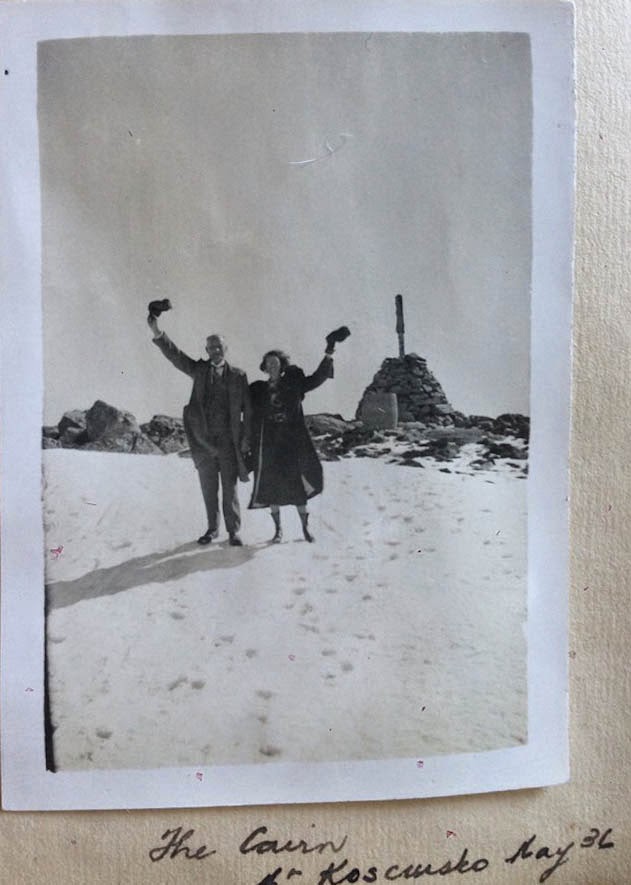
Way back in 1936, when Mt Kosciuszko - Australia's tallest mountain, at 2228m/7310ft - was still spelt Kosciusko (it was changed by the Geographical Names Board of NSW in 1997 to reflect the correct Polish spelling, named after General Tadeusz Kosciuszko), Uncle Les and Auntie Gen took a trip there with Auntie Gen's uncle and aunt, Norman and Mary Macindoe.

They travelled in a 1920s soft top Austin tourer (I think) and they must have been freezing!

They stayed at Hotel Kosciusko. Below is a photo of Uncle Norman and Aunt Mary in front of the hotel (though I actually think this may be the back of the hotel).

They spent a day walking to the summit of the mountain, and although Auntie Gen looks well rugged up, I love that her Uncle Norman is in a three piece suit and tie! The one shown in the photo below is the original cairn, which has since been rebuilt.

Despite the fact that they have rebuilt the cairn at the summit of Kosciuszko, the Seaman's Hut is still standing (here's a link to a recent photo), and looks like it hasn't aged since the following photo was taken. I still can't work out what a seaman would be doing up there on the mountain though!

17 April 2014

A family heirloom - a hand embroidered doily

I was given this embroidered doily after the death of my great aunt - it had been embroidered by her mother, my great grandmother, Ellen Paterson Wilkey née Macindoe (1876-20 Apr 1967). I treasure it because of my own love of embroidery, and have it framed and hanging on the wall in my bedroom. One day, when I meet her in heaven, my great grandmother may well ask me why I stuck it on the wall in a frame instead of using it!

The other day I was looking through some books on Antique Pattern Library, and was stunned when I came across the pattern! There is only one small difference that I can find in the way my great grandmother stitched it compared to the pattern and I'm quite convinced it is the pattern she followed. The pattern is from a DMC pattern book, Drawn Thread Work, edited by Thérésa de Dillmont, and was published in about 1895. This definitely fits within the time that my great grandmother might have been stitching.

Why do I think this is significant? I'd been told of my great grandmother's sewing skills, but finding the published pattern shows me that ordinary women stitched these designs - it wasn't mass produced in a factory somewhere. She was definitely talented - it's not an easy pattern!

21 June 2013

The short life of James Arthur Wilkey

James Arthur Wilkey was my great grandfather. He was born in Burwood, Sydney in 1877 to John and Mary Ann Wilkey. Comparatively little is known about my great grandfather, because he only lived to 30 years of age. For him there was no sitting around with the grandchildren, regaling them with stories of "When I was young...."

James Arthur, known just as "Arthur", was the seventh of nine children of John and Mary Ann Wilkey, though he only knew two of his older siblings because the others died in infancy or childhood.

James Arthur Wilkey on his wedding day.

The next event that history records in Arthur's life was his marriage, aged 25, to Ellen Paterson Macindoe in 1902, at Petersham, Sydney. They lived in a house in Wyatt Avenue, Burwood, and started a family - their first child, Helen Genevieve, was born in 1904. Arthur worked as a clerk. Then, in 1907, when Ellen, known as Nell, was newly pregnant with their second child, named James Arthur Macindoe Wilkey (known as Arthur, like his father), tragedy befell the family.

Evening News, 16 Sep 1907. Accessed via Trove on 21 Jun 2013. Note that Arthur's name is quoted incorrectly.

The accident occurred at about 8am on Monday 16 September. Nell sat up all Monday night, praying for her husband, with her mother, sister Maggie, brother Norman, and a few friends. I cannot begin to imagine her emotional state at the plight of her husband, especially in her pregnant condition, but her brother Norman described it thus in his diary: "Remained up all Tuesday night sharing Nell's heart agony, also portion of Wednesday night". Tragically, Arthur died the day after the accident at about 1pm. He was buried at Rookwood Cemetery on 19 September 1907.

Witnesses at the inquest into his death described how, after his train had left Burwood Station on its journey towards Sydney, as he stood on the platform of the train, his hat blew off when another train passed, and in a effort to catch it, he fell from the train. A verdict of accidental death was recorded.

Life for Nell after her husband's death was hard, though her family was there to help her. She gave birth to their son Arthur in the following April. Some of Nell's brothers took a particular interest in young Arthur as he grew up, to provide him with a father figure.

I've often wondered how the family survived financially after Arthur's death, as there was no longer a breadwinner in the family. This question was answered when I looked at Arthur's deceased estate papers at State Records: on the 31 Dec 1898 when he was 21, Arthur took out a £100 life insurance policy with the Australian Mutual Provident Society. When he died, the policy paid out £111. That would certainly have helped provide for the family.

01 July 2012

Completely disinherited

I was out at State Records the other day, looking at probate records. One of the families I looked into was the Macindoes, as a result of this post. I will write about the results of that investigation another time, however this current post deals with one of the biggest surprises of the day.

Ruth Bevan Macindoe (1899-1979), my first cousin twice removed, was the second child of Norman and Mary Macindoe. She studied medicine at the University of Sydney during the late 1910s, early 1920s. She travelled to England in 1922 with her mother Mary (and presumably back again because she died in Australia), and then the trail goes cold.

The family story goes that, with her medical training, she diagnosed herself with a severe mental illness and had herself committed. I've not been able to find any record of her residence in a mental institution, but that's unlikely anyway because health records are closed for 110 years. Certainly, she disappeared without a trace. All her siblings, male and female, voted in elections (voting in elections is compulsory in Australia), Ruth did not. If she was in a mental institution she may well have been exempt from voting.

Her father's will provided for all his children except her. In fact, the typed will has a handwritten addition to it where, in setting out the share for each of the daughters and sons, it says "except for my daughter Ruth Bevan Macindoe who is to be completely disinherited".

Was it because she had brought disgrace to the family by having a mental illness? One could expect that it might be a very good reason to actually provide for her and for her care, but apparently not. If you were worried that she wasn't of sound mind and therefore unable to look after any money she might inherit then surely you could provide for her care. One family member who I talked to about this said that there were certain things in the family that just weren't spoken of, and so she didn't really have much of an idea of what became of Ruth Bevan Macindoe.

Ruth died in 1979 at the age of 80. There was no death or funeral notice published. Unlike her unmarried sisters she was not buried with her parents.

I don't know that I will ever find out exactly why Ruth Bevan Macindoe was completely disinherited by her father. It is a very sad tale and I guess we can only hope that attitudes to mental illness continue to change for the better.

21 April 2012

The issue of the court case over Thomas Macindoe's will

It has long been assumed by living members of the Macindoe family that the court case over Thomas Macindoe's (1841-1901) will - being about the appointment of the executors - frittered away most of the money in the estate, and this was why the mysterious death bed message, that Thomas set aside £100 for the publication of, was apparently never published. Although the court case made the papers, it did not appear to be a long and protracted affair which might have sucked up all the money. Was it only the absence of the publication of the death bed message that made us all think that?

The other day I was looking through the probate records for Thomas' daughter Margaret Kirkwood (Maggie) Macindoe (1883-1929), and now I'm really wondering if all the money did disappear into legal coffers. Because when Maggie died she owned one of the properties that her father Thomas had in his estate i.e. it was most likely part of her share of the inheritance. So now I wonder, did any of Maggie's siblings own properties listed in their father's estate as well? I haven't seen the probate records for any of Maggie's siblings, but State Records holds a number of them: Thomas Macindoe jnr (1870-1947), Walter Walker Macindoe (1866-1955), Andrew Paterson Macindoe (1868-1956), and Norman Macindoe (1874-1956). As well as that, though Stewart Macindoe's (1872-1944) probate records are not held, his wife Mattie Carr Macindoe's (1875-1962) are, and considering she died after him, any property in his name may have been willed to her.

So that's another trip to State Records required. It will be interesting to see if any of the other children owned properties listed in their father's estate as well. Perhaps it was just that none of his children wanted his death bed message published, even if there was enough money there for it. I wonder what it said!!

18 March 2012

W.W. Macindoe in Dorrigo

My great great uncle Walter Walker Macindoe was born in Govan, Lanarkshire, Scotland on 1 November 1866. He emigrated to Australia in 1884 with his family, on account of him having a weak constitution - it was thought the fresh Australian air might be better for him. Considering he died aged about 90, in 1955, it certainly seems to have done him no harm!

W.W. Macindoe married Matilda Francis in 1889, and they, with their four children moved to Dorrigo, NSW, in 1911. You can read some of what he wrote about moving to Dorrigo here. He had selected a plot of land, and he and his eldest son worked extremely hard to tame the land and make something of it. His descendants still live in the area.

I was interested to find the plot of land on a parish map, and so set about looking. According to the electoral lists of 1930 and 1936 his address was North Dorrigo. Looking at parish maps for land north of the village of Dorrigo I had no luck finding the name W.W. Macindoe, so I tried looking in the historical newspapers of Trove to see if there was anything on him and his selection of land. A search of "Macindoe Dorrigo" produced a result in the Clarence and Richmond Examiner for 7 July 1914 in an article on Crown Lands: "... also for road; also within W.W. Macindoe's portion 23, parish Meldrum Downs."

So this narrowed down the parish, and gave me the portion number for the land. I put "Meldrum" into the Parish Map Preservation Project website, clicked on "Meldrum Downs" and chose the first map available from after 1911. Right up the top, in the righthand corner I found Walter Macindoe's land. It was purchased as a Conditional Purchase in August 1908 and was 300 acres, 1 rood, excluding the road running through it. It was north of the village of Deer Vale, so I looked up Deer Vale in Google Maps, and found it west of Dorrigo. North of Deer Vale I found a road named "McIndoes Road" leading up to the land he owned - no need to guess who that was named after!

26 December 2011

2011 - The year in review

So much has happened this year - I've found out so many new things about my family history - that I thought I would review my research, and highlight the most intriguing and/or amazing bits.

Best Performance in a Television Series:
Thomas Wickham (1888-1973)

Thomas Wickham was my great great uncle. He was a policeman in Sydney and worked as a detective sergeant in NSW's first drug squad. He was portrayed in the television series Underbelly: Razor. I didn't watch it, but as far as I know, he's my only relative who's been dramatised in a television series!

Story That Still Leaves Me Gobsmacked That I Uncovered It:
Charles Nicholas Weiss (1789-1845) and Gaspard Weiss (1739-1815), flute virtuosos

Charles Nicholas Weiss (my great great great grandfather) and his father Gaspard Weiss (my great great great great grandfather) were both very talented flautists. Both born in Mulhouse (now part of France), they both trod a path through Italy and Geneva to England where they achieved a level of fame for their musical skills. Gaspard retired back to Mulhouse, Charles joined the British Army and died young in India.

I still am amazed at what I uncovered on Charles Nicholas Weiss. The family had a vague idea that he was born in Prussia (wrong), and was in the army and died in India. I don't think anyone really realised that he was a (then) famous flautist, who joined the British Army as a bandmaster because of his musical skills.

Plus, I've never explained how I found out about Gaspard Weiss, his father. I had worked out that Charles had been born in Mulhouse, so I found a local Alsace genealogical society (Centre Départemental d' Histoire des Familles) and sent them an email asking if they had any information on him. A few weeks later I received an envelope in the mail from them, containing all they had on him: a photocopy from "Nouveau dictionnaire de biography alsacienne", which had a short biography on him. However, the startling thing was that it noted that Charles Nicholas Weiss was the son of the entry before: Jean Gaspard Weiss. And that is where I discovered his possibly even more famous father, Gaspard Weiss. Just because I happened to send an email to a family history society in Alsace.

Ancestor I Would Have Most Liked to Meet:
Caroline Beringer (c1857-1896)

Caroline was my great great grandmother. She came to Australia from Germany with her husband and two young children. She had more children once they were here, but Caroline tragically committed suicide when only 39 years old. I imagine it was a combination of loneliness, homesickness and post-natal depression that drove her to it. I would like to think that, had I been alive, I would have been able to befriend her.

Ancestor I'd Most Like to Find Out More About in the Coming Year:
Margaret Kirkwood Macindoe (1883-1929)

Maggie was my great great aunt. She was born in Scotland and came out to Australia with the rest of her family at a very young age. She died in Callan Park Mental Hospital in Rozelle, NSW, aged just 46, having been hospitalised a number of times in her life. I'm not expecting to get access to her medical records because there is a 100 year restriction on access to medical records, but I'd love to find out why she was in the mental hospital. I can't imagine that it was a good place to die.

Death Bed Message That I'd Love to Read:
Thomas Macindoe (1841-1901)
Thomas Macindoe was my great great grandfather. He was a difficult man, who'd been brought up by an alcoholic mother, and whose wife also turned to drink. Upon his death there was a death bed message that was supposed to published in the newspapers. His children went to court over his will and frittered away all the inheritance, apparently leaving no money for the publication of the death bed message. I'd love to know what it said! It is supposed that it was probably about the evils of drink, but that's just guessing.

Relative Who Met the Most Unusual Death:
Theophile Augustus Naudin (c1845-1880)
Augustus Naudin was the first husband of my great great grandmother. After Augustus died she later married the man who was my great great grandfather. Augustus was eaten by cannibals in Papua New Guinea, leaving behind two wives (whom he bigamously married) with 5 or 6 children as well. They were possibly better off without him!

20 December 2011

Who was the Rev James Dunlop married to?

I have been going through an old photo album of my great aunt's, scanning the photos, as well as trying to work out who they all are. Apart from having many many photos of my ancestors in the Paterson and Macindoe families, it has produced some puzzles for me to solve as well.

The latest puzzle I've been working on is "Rev Dunlop" and his wife "Mrs Dunlop". According to the photos, the Rev Dunlop was married to one of my great great grandfather Thomas Macindoe's sisters. As far as I know Thomas had four sisters: Mary McIndoe (it seems that Thomas used the "Macindoe" spelling of his surname, but the rest of his family generally used "McIndoe"), born 7 April 1826, Margaret McIndoe, born about 1838, Jane McIndoe, born about 1840, and Jeanie McIndoe, born about 1843.

Of these four sisters I know that the youngest sister Jeanie McIndoe married Thomas Weir, from a marriage notice in the Glasgow Herald:

"At Albion Cottage, Helensburgh, on the 12th inst., by the Rev. James Dunlop, Motherwell, assisted by the Rev. John Lindsay, Helensburgh, Mr THOMAS WEIR, writer, Glasgow, to JEANIE, youngest daughter of the late WALTER MACINDOE, Esq., of Ashfield." Glasgow Herald, 13 August 1875.

I don't think it is too presumptuous to assume that the Rev James Dunlop who married Thomas Weir to Jeanie McIndoe was the Rev Dunlop who was married to Jeanie's sister, especially considering he was "imported" in from a different parish to celebrate the marriage. So, clearly, his first name was James.

Searching historical newspapers, I hoped to find a marriage notice for Rev James Dunlop. No such luck. However, I did find his death notice:

"MOTHERWELL. - DEATH of a U.P. MINISTER. - Yesterday morning the Rev. James Dunlop, U.P. minister at Motherwell, died in the 60th year of his age and the 36th of his ministry. Mr Dunlop, through failing health, found it necessary lately to resign his charge. He was born in Irvine in 1823, and was educated at Glasgow University, where he took the degreee of M.A. He laboured at Biggar for nineteen years prior to being called to Motherwell." Glasgow Herald, 26 January 1883. [U.P. stands for United Presbyterian.]

Googling him, I found out he had two ordained brothers, the Rev Hugh Dunlop and the Rev William Dunlop, and he himself was ordained on 14 April 1847, and he accepted a call to the Motherwell parish in 1866. Still no mention of a wife though.

I am guessing that the wife could be Mary McIndoe, mainly because she's the closest in age to James Dunlop. A search on FamilySearch revealed two options: two marriages between a James Dunlop and a Mary McIndoe - one a marriage in Biggar, Lanarkshire in July 1851, the other a marriage in Kilmaronock, Dunbartonshire on 4 July 1851. My hunch is that this is the same event, registered in two places, probably each person's home parish. I could check on Scotlands People, but I would have to pay then, and I prefer to do my genealogical research for free if possible. It must be my Scottish heritage!

Further searching on FamilySearch revealed children of the marriage, the first being named Walter Macindoe Dunlop. I think that clinches it - the first son named after Mary's father. Finally, I've worked out that the Rev James Dunlop was married to Mary McIndoe!

16 November 2011

The Macindoe family

The photo above was taken of the Macindoe family before they left Glasgow for Sydney. By my reckoning, which could be wrong, the people are as follows:

back row: Walter Walker (1866-1955), Andrew Paterson (1868-1956)

middle row: Stewart (1872-1944), Ellen (seated, 1845-1922), Ellen Paterson ("Nellie", 1876-1967), Thomas (seated, 1841-1901), Norman (1874-1956), Thomas (1870-1947)

front row: Margaret Kirkwood ("Maggie", seated on her mother's lap, 1883-1929), John (1879-1953)

01 November 2011

Thomas Macindoe, estate agent

Knowing that Thomas Macindoe placed a number of advertisements in the Sydney Morning Herald in the year after they arrived in Australia, for the real estate business that he started up in Petersham, I decided to check whether he used to advertise in Glasgow as well.

It turns out that he advertised his real estate business in the Glasgow Herald very regularly from around the time of his marriage (1866) until just before he left for Australia in 1884. It would seem that he sold the business a few months before he emigrated (to a Mr Lauder?) because the name of the firm suddenly changed to "Thomas Macindoe and Lauder". But considering he advertised so solidly for many years in Glasgow, it makes me wonder if he stopped working after only about a year working here in Sydney - certainly he stopped advertising after 1885.

Interestingly, on a number of his children's birth records as well as his own marriage record he is noted as an accountant (and increasingly as a "house factor" i.e. estate agent as well). He seems to have slowly given up the accountancy and focused on the estate agency as time went on.

I also found a short article about Thomas Macindoe moving to Sydney:

PRESENTATION TO MR THOMAS MACINDOE - Yesterday afternoon Mr Thomas Macindoe, house and property agent, was presented with an illuminated address by a number of his friends on the occasion of his leaving Glasgow for Sydney, New South Wales. The presentation was made in the drawing room of the George Hotel, where cake and wine were served. Mr David Bannerman presided. In the address, which was beautifully illuminated, the subscribers recorded their high sense of Mr Macindoe's worth, and expressed their conviction that if he was spared, those qualities of perseverance and constant attention to business and to the interests of his clients, combined with integrity and promptitude in all his dealings, which had brought him success in Glasgow, would soon yield a similar result in his new sphere of work. They sincerely hoped that the main object which he had in view, viz., the benefit of his family's health, would be attained, and that there were in store for him many years of comfort and happiness. Glasgow Herald, 18 July 1884.

So they moved for the health benefits of living in Sydney. Was someone particularly unwell, or was it just that they wanted fresh air, wide open spaces and a new outlook on life? I do know that Thomas' wife, Ellen Paterson Macindoe became an alcoholic, but I'm not sure exactly when this became a problem. Perhaps it was for her benefit that they emigrated to Australia?

28 October 2011

The litigious branch of the family

My great great grandfather Thomas Macindoe (born 15 Oct 1841, Airdrie, Lanarkshire, Scotland, died 8 May 1901, Ashfield, NSW, Australia) died a very wealthy man. His deceased estate papers state that he was a "Gentleman", and he owned 12 properties with the value of his estate amounting to £4746.

As far as I know, my living family did not really know how he came by such a fortune, and probably we all assumed that he was a just Scot who was very canny with his money. Certainly the Macindoe family had enough money to pay their way out to Australia, arriving as Unassisted Immigrants on the Liguria in 1884 - which wouldn't have been a tiny expense, considering the family consisted of Thomas, his wife Ellen, and their eight children. Yesterday I discovered, looking through historical newspapers, that within months of arriving in Australia he had set himself up as a house and land agent based in Petersham, and so a job like that certainly would have helped him come by quite so many properties. According to one advertisement he placed he was quite experienced in this profession:

"PETERSHAM - THOMAS MACINDOE (late of Glasgow, 19 years an extensive House and Property Agent), opposite Railway Station, Petersham, has every facility for selling of Houses and Land, and Letting of Houses. Instructions to dispose of Property will receive prompt and personal attention." Sydney Morning Herald, 14 March 1885.

After he died Thomas Macindoe's will and two codicils caused a lot of problems amongst his family. He had originally chosen his wife Ellen and four of his sons (W. W. Macindoe, Thomas Macindoe jnr, Stewart Macindoe and Norman Macindoe) as executors, but in a second codicil dated 2 Apr 1901 he revoked the appointment of W. W. and Thomas jnr. It probably didn't help the situation that he lent Stewart £250 (of which he paid back £95) and Norman £110 and then, according to them, released them from the remainder of their debts, due to "the natural love and affection" of their father. In the end the family took sides and everyone, apart from the two daughters, went to court - not to contest the will, mind you, just the appointment of the executors. In the end a settlement was reached, for the plaintiffs (Ellen, Stewart and Norman), and the court costs were to be paid out of the estate. The judge for the matter then noted that "he hoped this would be the commencement of more cordial relations between the members of the family". The most ridiculous thing about the court case was that the court costs sucked most of the money out of the estate, leaving not much left over.

Thomas Macindoe's will gave provisions for up to £100 to be spent on the publishing of a "death bed message". No evidence has ever been found that the message was published, so one must assume that the court case frittered away the money so that there was not enough left to publish it. Which is incredibly annoying because I'd love to know what that mysterious death bed message was!

The court case was all written up in the papers, and apparently later at least some of the family expressed regret that they had dragged the family name through the mud. However, some of them didn't learn, particularly Thomas Macindoe jnr, who went to court with his estranged wife over the amount of maintenance he was paying her, and then his sons went to court over a punch up and slander - one complained the other slandered him when he told a doctor that he was subnormal and should have mental treatment. It would be funny if it weren't so sad.