On my trip to Rookwood Cemetery the other day we visited the grave of Samuel Merrick, as I knew there was an inscription in italics that I previously hadn't been able to decipher, but I thought my aunt and I together might have more success.
The engraving on this section of the gravestone was very worn, and very difficult to read, but in the end we managed to pick out enough words to work it out, with the help of Google!
Now the labourer's task is o'er
Now the battle day is past
Now upon the farther shore
Lands the voyager at last.
Father in thy gracious keeping
Leave we now thy servant sleeping.
The inscription is the first verse of the hymn "Now the labourer's task is o'er". It seems a very appropriate verse to have on Samuel's gravestone - he was a labourer - a bootmaker. I also like the imagery of the farther shore - this refers to heaven, but it also alludes to Samuel's own journey from Sligo, Ireland, to Sydney, Australia.
04 August 2013


03 August 2013
The grave of James and Susanna Ball
The other day my aunt and I visited Rookwood Cemetery to see if we could locate the grave of James and Susanna Ball. They are buried in the Anglican cemetery, section B, in graves 274 and 275. Until recently, there were no good markers in the Anglican section to give you any idea of what the grave numbers were, but a little while ago someone went through and put in little white stakes, with numbers on them at the ends of the rows. SOOO helpful!
We located the right row and walked along but it didn't leap out at us. Closer inspection found it, with the headstone fallen onto the actual grave, though it was at least right-side up, and completely overgrown by grass, bulbs and a couple of camphor laurel saplings. We cleared away the grass and leaves as best we could and attempted to transcribe it. It was very weathered in places, so it took us quite some time to work it all out - we think we've got it all correct!

Also to the memory of
"She hath done what she could" suggests a woman who had a hard life but did her very best under often trying circumstances. Considering Susanna Ball lost four infant children, her husband was in debtors prison for at least two months, and she travelled with her family all the way to the other side of the world to begin a new life in a foreign land, never to return "home", I certainly think she faced some hardship.
The quote in italics is from the hymn "There is a Fountain" by William Cowper. It gives us some idea of what Susanna believed, that once her mortal body died she would be in heaven, singing the praises of her saviour Jesus.
We located the right row and walked along but it didn't leap out at us. Closer inspection found it, with the headstone fallen onto the actual grave, though it was at least right-side up, and completely overgrown by grass, bulbs and a couple of camphor laurel saplings. We cleared away the grass and leaves as best we could and attempted to transcribe it. It was very weathered in places, so it took us quite some time to work it all out - we think we've got it all correct!

Sacred to the Memory
of
Susanna
the beloved wife of
James Ball
of Botany Road Redfern
who departed this life
October 23rd 1871
aged 57 years
She hath done what she could.
Now in a nobler sweeter song
I sing His power to save,
Whilst my poor lisping stammering tongue
Lies silent in the grave.
Also to the memory of
her four children who died in the City of London
Thomas John aged 3, Emma aged 2
Mary Ann aged 2, Arthur Henry 1
Also the above
James Ball
who died 7 May 1879
aged 66 years
The memory of the just is blessed.
Also
Louis Affriatt
infant son of
Henry A and Louisa Wilson
and grandson of the above
Died 2nd June 1879 aged 13 months
Thy will be done
Also
Elsie Louisa Wilson
Died 27th October 1883
Aged 16 months
"She hath done what she could" suggests a woman who had a hard life but did her very best under often trying circumstances. Considering Susanna Ball lost four infant children, her husband was in debtors prison for at least two months, and she travelled with her family all the way to the other side of the world to begin a new life in a foreign land, never to return "home", I certainly think she faced some hardship.
The quote in italics is from the hymn "There is a Fountain" by William Cowper. It gives us some idea of what Susanna believed, that once her mortal body died she would be in heaven, singing the praises of her saviour Jesus.
29 July 2013
James Ball, bookbinder AND carpenter
The Ball family in England is one of the parts of my family that I have found frustratingly little about. But every now and then I try all my usual searches on them to see if any new information has been loaded onto Ancestry, Findmypast and FamilySearch.
Yesterday I was looking up James Ball, my great great great grandfather, and discovered something new. Even though I knew he died in Sydney, after emigrating from England in 1857, I was looking under the British parish records collection for burials. For some reason they have details of some Sydney burials in there (I don't quite understand why), and I happened upon the burial records for James and his wife Susannah. I've looked for them before out at Rookwood Cemetery, but had not been able to locate the graves, as the Anglican section of the cemetery at that time was completely unmapped.
However, I discovered yesterday that with the graves for James and Susannah is also a memorial for four of their children "who died in the City of London": Thomas John, aged 3, Emma, aged 2, Mary Ann, aged 2, and Arthur Henry, aged 1. Although it didn't note the children's dates of death, this was a starting point as I previously had no knowledge of their existence, apart from Thomas John!
I already knew that Thomas John had been buried in the Middle Ground of the New Bunhill Fields Burial Ground, Islington, on May 2, 1844 - this was known from the London Non-conformist registers. I then managed to find that Mary Ann was buried at St Gregory by St Paul, aged 15 months, on 28 March 1850, her abode given as 20 Little Carter Street. I still cannot find anything in relation to Emma and Arthur Henry, but at least I'm aware of their existence now!
Thomas John and Mary Ann were buried in different graveyards, under different Christian denominations (St Gregory by St Paul is Church of England, non-conformist churches were other protestant churches, such as Methodist, Baptist etc) and I wondered why this was. Checking the known baptisms for all the Ball children, I found some previously undiscovered ones: Susannah, Louisa and Eliza (Eliza Jane) were baptised together at St Jude's, Bethnal Green (Church of England) on 11 May 1856, with their actual birthdates noted (Susannah: 27 May 1843, Louisa: 22 August 1845, Eliza Jane: 30 July 1847). When they emigrated to Australia, their religion was noted as Independent, however James and Susannah were buried in the Church of England (now Anglican) section of Rookwood Cemetery when they died. When their children married in Australia, they were married by Presbyterian and Wesleyan Methodist ministers. I tend to think that they gravitated to the nearest church wherever they were, but perhaps had a soft spot for non-conformist denominations.
The baptism records for the three girls also noted their father James was a carpenter, and that they lived at 1 Johns Place, Essex Street. I have puzzled before over James as a carpenter - the only reference I had previously found was in the immigration records when they arrived in Australia, despite the fact that I know he worked as a bookbinder in Little Carter Lane, London, and also in Redfern, Sydney. So it made me wonder what it might be that made him change profession before leaving for Australia. I wondered if his bookbinding business might have gone bankrupt. After some searching, I found that's exactly what did happen.
The first I can find of it is a notice in the London Gazette that he was to appear at the Court for Relief of Insolvent Debtors on 7 January 1854: "James Ball, late of No. 23 Lambeth-hill, Thames Street, London, Stationer and Bookbinder - in the Debtors' Prison for London and Middlesex." Another notice stated that he was formerly of 20 Little Carter-lane, then and late of 23 Lambeth-hill, Thames St.
He was imprisoned because of his debts. What happened to his family while he was in prison? If he was unable to pay his debts, I'm sure he wouldn't have been able to afford the rest on the house they were living in, so where did they live? According to immigration records, James' wife Susannah was a house servant, and possibly her meagre income was what they lived off during this time.
The Morning Post of 27 February 1854 contained a small article about the case:
"THE CITY IMPROVEMENTS - IN RE JAMES BALLIt rather suggests that James was slightly naive in his business dealings...
This insolvent, a bookbinder, &c., applied under the Protection Act. Mr Sargood opposed. The case created some laughter. The insolvent attributed his insolvency to the removal of his business from Carter-lane in consequence of the City improvements. He got 200l., having asked for 400l. He heard it was usual to get half of what was asked. (A laugh.) He then went to Lambeth-hill, hoping another line of improvement might be made, so that he might make a speculation, but he had been disappointed (laughter). The case adjourned to serve a creditor."
On March 24 1854 the Morning Post reported:

I don't understand half of that article, nor really what the outcome was, but it apparently left James in the position of no longer having a bookbinding business, so he clearly took up carpentry instead, and worked as a carpenter until the family emigrated to Australia. At some stage he then was able to buy some more bookbinding equipment and he took up bookbinding again in Redfern, Sydney.
16 July 2013
Tom Wickham, retired policeman
Recently a reader (Graham Sciberras - thank you so much Graham!) sent me a link to a 1962 ABC Four Corners report on the gentrification of Paddington, an inner-city suburb of Sydney. The report is interesting to watch because of the hilarious English accent that so many of the reporters of the day affected, but also, and most importantly, because my great great uncle, Tom Wickham is featured in it. I've seen a few photos of him before, but never seen film of him, so this was brilliant to see!
Mum was visiting my grandfather recently, who is Tom's nephew, and though he is quite unwell, when Mum asked him, my grandfather did remember his Uncle Tom. So today Mum and I visited my grandfather again and showed him a still photo of Tom from the Four Corners report, and also some of the footage from the story. Sadly, the other day my grandfather must have been more lucid because today he just kept looking at the photo and shaking his head. Because of his illness I don't think he could get his head around the fact that this was someone he once knew.
However, should you be interested in what Tom Wickham, retired policeman, looked like in 1962, pop over here and take a look - he's about 2 minutes in. There is a big resemblance to my grandfather. And then compare him to how they imagined him in Underbelly: Razor - slightly different!
 |
| Tom Wickham, interviewed for ABC Four Corners, 1962 |
 |
| Steve Le Marquand, as Tom Wickham for Underbelly: Razor |
21 June 2013
The short life of James Arthur Wilkey
James Arthur Wilkey was my great grandfather. He was born in Burwood, Sydney in 1877 to John and Mary Ann Wilkey. Comparatively little is known about my great grandfather, because he only lived to 30 years of age. For him there was no sitting around with the grandchildren, regaling them with stories of "When I was young...."
James Arthur, known just as "Arthur", was the seventh of nine children of John and Mary Ann Wilkey, though he only knew two of his older siblings because the others died in infancy or childhood.
.jpg) |
| James Arthur Wilkey on his wedding day. |
The next event that history records in Arthur's life was his marriage, aged 25, to Ellen Paterson Macindoe in 1902, at Petersham, Sydney. They lived in a house in Wyatt Avenue, Burwood, and started a family - their first child, Helen Genevieve, was born in 1904. Arthur worked as a clerk. Then, in 1907, when Ellen, known as Nell, was newly pregnant with their second child, named James Arthur Macindoe Wilkey (known as Arthur, like his father), tragedy befell the family.
 |
| Evening News, 16 Sep 1907. Accessed via Trove on 21 Jun 2013. Note that Arthur's name is quoted incorrectly. |
The accident occurred at about 8am on Monday 16 September. Nell sat up all Monday night, praying for her husband, with her mother, sister Maggie, brother Norman, and a few friends. I cannot begin to imagine her emotional state at the plight of her husband, especially in her pregnant condition, but her brother Norman described it thus in his diary: "Remained up all Tuesday night sharing Nell's heart agony, also portion of Wednesday night". Tragically, Arthur died the day after the accident at about 1pm. He was buried at Rookwood Cemetery on 19 September 1907.
Witnesses at the inquest into his death described how, after his train had left Burwood Station on its journey towards Sydney, as he stood on the platform of the train, his hat blew off when another train passed, and in a effort to catch it, he fell from the train. A verdict of accidental death was recorded.
Life for Nell after her husband's death was hard, though her family was there to help her. She gave birth to their son Arthur in the following April. Some of Nell's brothers took a particular interest in young Arthur as he grew up, to provide him with a father figure.
I've often wondered how the family survived financially after Arthur's death, as there was no longer a breadwinner in the family. This question was answered when I looked at Arthur's deceased estate papers at State Records: on the 31 Dec 1898 when he was 21, Arthur took out a £100 life insurance policy with the Australian Mutual Provident Society. When he died, the policy paid out £111. That would certainly have helped provide for the family.
29 April 2013
A not necessarily comprehensive guide to English family history research in the 1700s
The further you go back in history, the harder it is to find much information that might be useful to your family history research. Parish records can be incredibly useful for researching more recent generations, but as far back as the 1700s the parish records don't contain much. With a baptism record you're likely to get the parents names of the baptised child, but that's about it - if you're really lucky you might get a date of birth as well. Places of abode and occupation of the father were not recorded. Burial records will only give you the date the person was buried, and if you're lucky, they might list the age of the deceased.
So in the 1700s you have to look to other sources for further information. These include historical newspapers and wills. Of course, if your relatives were in the lower classes, you're unlikely to have much success at all - they didn't tend to publicise their hatches, matches and dispatches in the daily rag, and neither did they usually have much to will away. Sorry! However, if you had some rellies in the middle and upper classes, you may be in luck.
Over the past few days I have spent some time working on Henry James Davison (who happens to be the grandson of the wife of my 6x great uncle). All I knew from his baptism record was that he was baptised at St Marylebone Church, Marylebone, London on August 10, 1780. It also recorded his parents' names - James and Charlotte, and that he was born on 16 July 1780 (bonus!). I also had found baptism records for two of his siblings, James Tully Davison (1776) and John Davison (1777) in the same parish, which suggested that the family might have lived locally for at least 5 years.
To find out a little more, my next step was to see if I could find wills for either of Henry's parents. Of course there would only be one for his mother if his father died first - my understanding is that otherwise, in those days pretty much everything a woman owned was actually owned by her husband. Looking on the National Archives (UK) website, I found a will of Charlotte Davison, Widow of Saint Marylebone, Middlesex, dated 6 April 1833. It was the only one there that could possibly be her, so I took a punt and ordered it. And luckily it was her. And it happened to mention "Ann" (maiden name unknown), the widow of her late son Henry James Davison. So this meant he was dead by 1833. I couldn't find a reasonable likely option for a will of Henry's father James Davison, so I tried a different tack.
I searched some historical newspapers for Henry James Davison to see whether he made the papers at all. In June 1804 he was admitted to a Bachelor of Laws through Trinity Hall, Cambridge (from The Bury and Norwich Post, 20 June 1804). I also found his death notice (The Morning Post, 18 April 1822):
DIED - On Sunday last, at his mother's house, In Chandos Street, Cavendish Square, Henry James Davison, Esq. of Little Berkhampstead, Herts. aged 41.It would seem that there can be a lot of variation in the spelling of "Berkhampstead". Interestingly, in his mother's will she had made reference to all her "printed books and prints whatever either at Berkhampsted or in London".
So now I had two places to google in relation to the surname Davison - Chandos Street, Cavendish Square, and Little Berkhampstead, Hertfordshire. The first combination on Google brought up a will at the National Archives (UK) - the will of a Henry Davison, of Chandos Street Cavendish Square, Middlesex. Being dated 1822, I realised that this was my Henry James Davison! In his will Henry left pretty much everything to his wife Anne, but also left 50 guineas apiece to each of his godchildren. Which suggests to me that he and Ann never had children, or at least if they did, they hadn't survived.
Then I googled "Davison" with "Little Berkhampstead" and a reference to "Ann Davison, wid." caught my eye. It appeared that in 1826, four years after the death of her first husband, Henry James Davison, Ann married William Horne, later Sir William Horne, a British barrister and politician. The fact that they named one of their sons Henry James Davison Horne clinched it for me that this was definitely the widow of Henry James Davison.
The Hertfordshire Archives has an online database, a search of which revealed a death notice for Henry James Davison published in the County Chronicle on 7 May 1822. Unfortunately I haven't been able to find access to this newspaper, so I don't know what hidden secrets the notice might reveal.
So that's about all I can find on him. But rather than just knowing when he was born, and to whom, I can build up a little picture of him. He was born to James and Charlotte Davison in 1780 and baptised in the family parish of St Marylebone about a month later. He studied law at Cambridge, receiving his bachelors degree when he was 24. His family had a connection to Little Berkhampstead in Hertfordshire, and he lived there, at least for a time, with his wife. Apparently they had no children - was there a medical reason for the lack of children? Henry died, aged 41, at his mother's house in Marylebone. That he died so relatively young, and at his mother's house instead of in his own home at Little Berkhampstead suggests to me that perhaps he was convalescing there and that it wasn't necessarily a sudden death. The extended family was not poor, having residences in both Marylebone and Little Berkhampstead (there is evidence that Henry wasn't the only Davison who spent time there - his parents appeared to have links there as well), which they apparently moved between from time to time, and 50 guineas for each of his godchildren wouldn't have been small either.
24 April 2013
A German gentleman
I was watching the Australian version of Who Do You Think You Are? recently, and was interested in some information I gleaned from the episode on comedian Adam Hills.
Adam had some ancestors in Germany and they happened to mention the meaning of the word "burger/bürger"- it actually translates as "citizen" or "townsman", but means "gentleman".
I knew from my translation of German parish records relating to my Beringer ancestors that there were some burgers amongst them. So I looked back through all my records and found that Valtin Beringer, my 3x great grandfather, was noted as "burger und müller auf der Lochmühle" in many parish records regarding his children, and I also found one record where my 5x great grandfather, Caspar Joseph Beringer, was also referred to as a burger (the death record of his son Lorenz, 14 Nov 1819).
19 March 2013
The baptism of Mary Baumgarten
I've been searching for some kind of birth/baptism record for Mary (Marie) Baumgarten, daughter of Samuel Christian Frederick Baumgarten (c1729-1798) and Mary Joynes (c1729-?), who was later the wife of Gaspard Weiss (1739-1815), for ages now.
I have a record (from the Burgerbuch of Mulhouse) which suggests that unlike all her siblings who were apparently born in London, England, she was from Nassau-Usingen (though perhaps not born there). I still was looking for some vital records for proof of this though. According to the marriage allegation for Gaspard Weiss and herself, she was born around 1755.
In the last week or so, Findmypast has released 3 million new Westminster records onto their website. I'd previously found lots of records for Baumgartens and Joynes and other related families in Westminster so I did some searching and hit pay-dirt! A "Mary Baumgarten" was baptised at St Margaret Westminster on 15 August 1755. She was recorded as the daughter of "Saml. Christian Frederick by Mary", born 21 July 1755. Mary's sister Charlotte was baptised in the same parish in 1757.
So the question is: was she born in Nassau-Usingen or England? I don't think there's likely to be a way to ever know that for sure, as I've never found any shipping records from that time, which could tell us that a (newborn?) Mary Baumgarten travelled with her parents across the English Channel to England... It does seem possible that there might have been enough time for them to get from Nassau-Usingen on 21 July to London on 15 August though. We'll probably never know...
12 March 2013
A trip to Waverley Cemetery
I recently managed to get to Waverley Cemetery to see some graves there. Waverley is a cemetery with a lovely setting - it is situated on the cliffs at Bronte, in the eastern suburbs of Sydney. It overlooks the Pacific Ocean, so the "guests" there have a great view, if only they weren't so dead that they couldn't enjoy the scenery. There were two lots of graves I wanted to check out - the Rich graves and the Horsey graves.
I started off with the Rich graves. I asked at the office as I had no idea where they were. For a $15 fee (which I think is steep, considering some cemeteries don't charge at all for information, but I guess they have to pay for up-keep somehow) they gave me a whole lot of details about where the graves were, and also offered the family with the chance to take over the lease of the graves as there was still room available. For only about $1700 for a 25 year lease. Otherwise, they may be recycled at some stage in the future - which makes me glad that I photographed them while I had the chance!
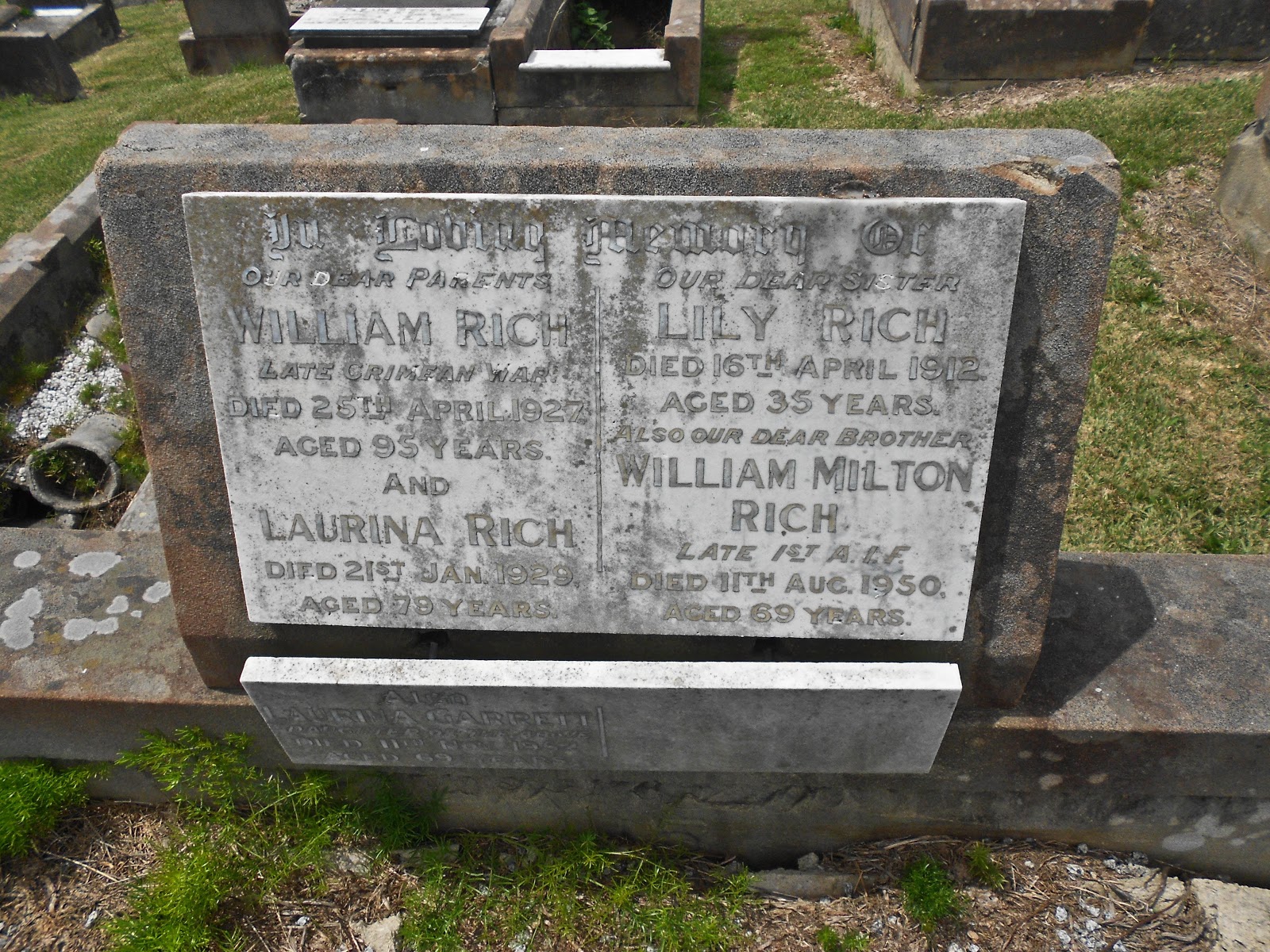
 The first photo shows the double grave for the assorted members of the Rich family buried there (Church of England, Section 15 Ordinary, graves 6206 and 6207), along with my little helper. The inscription that my little helper was sitting on said "Erected by Avice", Avice being one of William and Laurina's daughters.
The inscription on the headstone says:
"In Loving Memory of
Our dear parents William Rich, late Crimean War, died 25th April 1927, aged 95 years, and Laurina Rich, died 21st Jan 1929, aged 79 years.
Our dear sister Lily Rich, died 16th April 19112, aged 35 years.
Also our dear brother William Milton Rich, late 1st A.I.F., died 11th Aug 1950, aged 69 years."
On the lower section it says:
"Also Laurina Garrett, daughter of the above [William and Laurina], died 11th Nov 1962, aged 69 years."
Also buried in the grave is Laurina Garrett's husband Maurice, although there is no inscription bearing his name (though there is space for it next to his wife's details - clearly no one ever got around to it). He was buried there 23rd Aug 1956.

 This photo is of the grave of Sarah Horsey, and members of her extended family - James and Selina Baker, Charles, Selina Grace and Harriett Eliza Baker, and Frederick and Maria Ruth Horsey. The details of these graves are Church of England, Section 2 Ordinary, Row 10, graves 235-238.

The inscription on this headstone is:
"In Loving Memory of Sarah Horsey, native of Somersetshire England, who died June 21 1880, aged 64 years.
In such mournful visitation
On this sweet assurance rest
Whatsoever the dispensation
God's decree is always best"
There is definitely space at the bottom of this headstone for details of further burials, but apparently there were none. Josiah, Sarah's husband, was buried in the Devonshire Street Cemetery, which closed in 1867, thus explaining why Sarah wasn't buried there with him. The Devonshire Street Cemetery was resumed in 1901 to make way for the building of Central Station, but I've never been able to work out where Josiah's remains were moved to. Perhaps he was moved to Waverley and buried with Sarah, but the information never recorded on the headstone. If I was over that way again (it's a bit of drive from my place) with another spare $15 I could get them to look up the burial information for those graves, but as I had what seemed like most of the information at the time I didn't do it on this particular visit.
I started off with the Rich graves. I asked at the office as I had no idea where they were. For a $15 fee (which I think is steep, considering some cemeteries don't charge at all for information, but I guess they have to pay for up-keep somehow) they gave me a whole lot of details about where the graves were, and also offered the family with the chance to take over the lease of the graves as there was still room available. For only about $1700 for a 25 year lease. Otherwise, they may be recycled at some stage in the future - which makes me glad that I photographed them while I had the chance!
 The first photo shows the double grave for the assorted members of the Rich family buried there (Church of England, Section 15 Ordinary, graves 6206 and 6207), along with my little helper. The inscription that my little helper was sitting on said "Erected by Avice", Avice being one of William and Laurina's daughters.
The inscription on the headstone says:
"In Loving Memory of
Our dear parents William Rich, late Crimean War, died 25th April 1927, aged 95 years, and Laurina Rich, died 21st Jan 1929, aged 79 years.
Our dear sister Lily Rich, died 16th April 19112, aged 35 years.
Also our dear brother William Milton Rich, late 1st A.I.F., died 11th Aug 1950, aged 69 years."
On the lower section it says:
"Also Laurina Garrett, daughter of the above [William and Laurina], died 11th Nov 1962, aged 69 years."
Also buried in the grave is Laurina Garrett's husband Maurice, although there is no inscription bearing his name (though there is space for it next to his wife's details - clearly no one ever got around to it). He was buried there 23rd Aug 1956.
 This photo is of the grave of Sarah Horsey, and members of her extended family - James and Selina Baker, Charles, Selina Grace and Harriett Eliza Baker, and Frederick and Maria Ruth Horsey. The details of these graves are Church of England, Section 2 Ordinary, Row 10, graves 235-238.
Selina Horsey was Sarah and Josiah Horsey's daughter. She was married to James Baker. James' brother Charles was married to Selina's sister (and Sarah and Josiah's daughter) Sarah Ann, and Selina Grace was their daughter, with Harriett Eliza being Charles' daughter from a previous marriage (his first wife died). Sarah Ann, Charles' wife is not buried in this grave as she remarried after the death of Charles, and so is presumably buried with her second husband elsewhere. Frederick Horsey is a son of Sarah and Josiah Horsey, and was married to Maria Ruth.

The inscription on this headstone is:
"In Loving Memory of Sarah Horsey, native of Somersetshire England, who died June 21 1880, aged 64 years.
In such mournful visitation
On this sweet assurance rest
Whatsoever the dispensation
God's decree is always best"
There is definitely space at the bottom of this headstone for details of further burials, but apparently there were none. Josiah, Sarah's husband, was buried in the Devonshire Street Cemetery, which closed in 1867, thus explaining why Sarah wasn't buried there with him. The Devonshire Street Cemetery was resumed in 1901 to make way for the building of Central Station, but I've never been able to work out where Josiah's remains were moved to. Perhaps he was moved to Waverley and buried with Sarah, but the information never recorded on the headstone. If I was over that way again (it's a bit of drive from my place) with another spare $15 I could get them to look up the burial information for those graves, but as I had what seemed like most of the information at the time I didn't do it on this particular visit.
10 March 2013
Who was the rich uncle?
Reading through the autobiography of Gaspard Weiss today I rediscovered something intriguing that I had read once before.
"Les enfants Baumgarten avaient hérite d'un oncle chacun environ £1500, soit 36000 francs. Cette ennuyeuse affaire, si importante pour les hommes de droit qui me réclamèrent 51 Guinées, retarda notre mariage jusqu'au mois d'août; de plus, par contrat, nous nous engagions, au cas où je retournerais dans mon pays, de placer ce capital en Angleterre au nom de mes enfants. M. Baumgarten vit au bout de quelque temps que cette clause était injuste et il fit tout ce qu'il put pour la faire modifier, afin que cet argent nous fût rendu." Weiss (2012).
Roughly translated, it says that each of the children of Samuel and Mary Baumgarten (née Joynes) inherited £1500 after one of their uncles died, and it was right before Gaspard Weiss and Marie Baumgarten were married in 1775. I'm pretty sure £1500 was a large amount then (the National Archives UK's currency calculator puts it at a value of £95500 in 2005's money), and considering at least four of them made it to adulthood (out of eleven children in total) that's a substantial amount of money to be passing on at the uncle's death.
On the paternal side I only know the date of death of one of Samuel Baumgarten's brothers - John Henry, who died in 1770. Having read his will, he left all his money to his siblings and not to nieces and nephews. I don't know of the wealth of any of Samuel's other brothers nor when they died. I do, however, suspect that the uncle in question lived in England, of which none of Samuel's other brothers did.
Of Mary Joynes' brothers, Bartholomew, Samuel, Thomas and Henry, I assume Bartholomew and Henry died young (likely in childhood) as they weren't mentioned in their father Henry Joynes' will - written in 1754, Thomas died at age 28 (1750), when he probably wouldn't have had time to amass a large fortune, but Samuel was a prominent lawyer who worked in the Middle Temple and had a number of high profile and/or high society clients. He certainly could have left a fortune of the magnitude left to the Baumgarten children. According to his will, Samuel Joynes, after divvying up most of his belongings amongst friends and family, left the remainder in equal shares to his sister's children - Mary and Samuel Baumgarten's children.
Samuel Joynes died on June 10, 1770, which fits with the uncle in question dying before 1775 when Marie Baumgarten and Gaspard Weiss married. So I don't know for certain, but I believe it was Samuel Joynes who left £1500 to Marie Baumgarten.
Subscribe to:
Posts (Atom)